
Editorial Process
Big.D operates a rigorous and transparent double-blind peer-review process designed to maximize academic quality, which, is handled by researchers and academic editors. Authors are advised to pay close attention to the pre-check procedure by the editorial office to avoid desk rejection. All submitted manuscripts are processed according to the workflow outlined below.
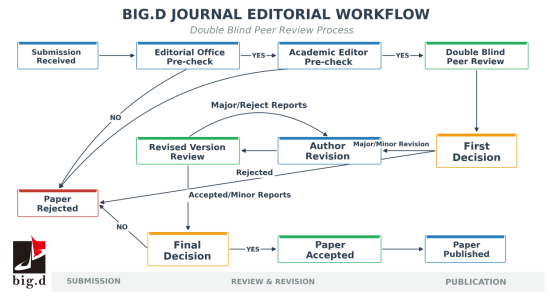
Overview of the Peer-Review Process
All manuscripts are evaluated through a double-blind peer-review process involving three independent reviewers. Final acceptance or rejection decisions are made by the Editor-in-Chief or other academic editors authorized by the Editor-in-Chief.
Pre-Review Stage
The pre-review stage consists of two main steps: a technical pre-check conducted by the editorial office and an editorial pre-check conducted by an academic editor.
Technical Pre-Check (Editorial Office)
Upon submission, the journal’s Executive Editor will perform the technical pre-check to assess:
- The overall suitability of the manuscript to the journal/section/special issue/topic/topical collection;
- The compliance with standards for high-quality research and publication ethics;
- Whether the rigor of the research meets the threshold for external peer review;
- Whether the paper format complies with the journal’s requirements.
Editorial Assessment (Academic Editor)
The academic editor (Editor-in-Chief for regular submissions; Guest Editor for special issues; Topic Editor for topical submissions; Collection Editor for topical collections; or an Editorial Board member appointed by the Editor-in-Chief in cases of conflict of interest) evaluates whether:
- The manuscript falls within the journal’s disciplinary scope;
- The work demonstrates basic academic or engineering value;
- There are any apparent ethical risks (e.g., data anomalies, authorship disputes);
- The manuscript meets the minimum academic quality threshold.
Based on this assessment, the academic editor may decide to reject the manuscript, request revision prior to peer review, or proceed to external peer review and recommend reviewers.
(3) Conflict of Interest Management
Guest Editors, Topic Editors, and Collection Editors are not permitted to handle manuscripts submitted to their own special issues, topics, or collections in order to avoid conflicts of interest. Such manuscripts are handled by Editorial Board members. The Editor-in-Chief and other Editorial Board members are likewise prohibited from accessing or influencing the review process of manuscripts on which they are listed as authors.
Peer Review
Double-Blind Review. Big.D adopts a double-blind peer-review system, in which reviewers are not informed of the authors’ identities, and authors are not informed of the reviewers’ identities.
Number of Reviewers. Each manuscript is evaluated based on three independent review reports.
Reviewer Selection.
- Academic editors may recommend reviewers during the pre-review stage;
- Reviewers may be selected by the editorial staff from the Editorial Board, reviewer databases, or through literature-based searches;
- Author recommendations or exclusions: Authors may suggest potential reviewers. All suggestions are subject to conflict-of-interest checks. Authors may also request the exclusion of specific reviewers; such requests will be respected provided they do not compromise objective evaluation.
Reviewer Eligibility. Reviewers must meet the following criteria:
- Hold a doctoral degree or possess equivalent research experience;
- Have no conflicts of interest with the authors and not be affiliated with the same institution;
- Demonstrate relevant expertise and a strong publication record, with no co-authored publications with the authors within the past three years.
Reviewer Responsibilities. Reviewers who accept an invitation are expected to:
- Possess appropriate expertise to judge manuscript quality, provide high-quality review reports and remain responsive throughout peer review;
- Base evaluations on evidence and professional judgment, offering specific, constructive, and respectful recommendations;
- Maintain confidentiality and promptly report any suspected misconduct, including plagiarism, duplicate publication, data or image impropriety, authorship disputes, or peer-review manipulation.
Review Criteria. Reviewers assess manuscripts based on:
- Originality and technical soundness;
- Adequacy of methods and experimental validation;
- Reliability of conclusions;
- Engineering relevance or application value.
Review Timeline. Reviewers are typically expected to complete reviews within 7-10 days. Reviews of revised manuscripts are normally requested within 3 days. Extensions may be granted upon request.
Author Revision Stage
When a decision of minor revision or major revision is issued, authors are invited to revise their manuscripts and resubmit them for editorial evaluation. If reviewer opinions conflict or include recommendations for rejection, the editorial office consults the academic editor before communicating a revision decision to the authors. The academic editor may request additional reviewers or further review at this stage.
- Resubmission to Reviewers: Whether a revised manuscript is returned to reviewers depends on the nature of the revisions. Manuscripts requiring major revision or involving prior rejection recommendations are typically sent back to reviewers.
- Rounds of Revision: Manuscripts generally undergo one to two rounds of revision. Minor revisions are often assessed directly by the editor without further external review. Major revisions usually undergo at least one additional round of external review. If core academic or technical issues remain unresolved after multiple rounds, the manuscript may be rejected to ensure review efficiency and publication quality.
- Revision Timeframe: If authors anticipate that revisions will require more than two months, withdrawal and resubmission are recommended to allow adequate time for revision.
Editorial Decision
After receiving three review reports, the academic editor makes a decision regarding acceptance. Decisions are made by the academic editor (Editor-in-Chief, Guest Editor, Topic Editor, or another appropriate Editorial Board member). Editors may not participate in the editorial handling, peer review, or decision-making for their own manuscripts.
Decision Criteria: Editors evaluate:
- The appropriateness of reviewer selection;
- The adequacy of reviewer comments and author responses;
- The overall scientific and technical quality of the manuscript.
Decision Options: Editors may decide to:
- Accept without revision;
- Accept after minor revision;
- Reject without resubmission;
- Reject with encouragement to resubmit;
- Request further revision or additional reviewers.
Handling Divergent Opinions: If an academic editor supports acceptance while reviewers recommend rejection, the editorial office will seek a second opinion from another Editorial Board member or the Editor-in-Chief before issuing a final decision.
Final Notification: Only academic editors are authorized to make acceptance decisions. The editorial office subsequently notifies authors. Editorial staff do not make acceptance decisions.
Special Issues
All articles submitted to Special Issues are subject to the same rigorous and impartial peer-review process as regular submissions. Guest Editors oversee the editorial process for all Special Issue manuscripts and provide a consolidated recommendation based on all reviewer reports. Manuscripts submitted by Guest Editors to their own Special Issue must be handled through an independent review process and may not exceed 25% of the total number of articles published in that Special Issue.
Author Appeals
Authors may submit an appeal against a rejection decision by contacting the journal’s editorial office via email. Appeals must present a detailed justification, including a point-by-point response to the comments provided by the reviewers and/or editors. Appeals may be submitted only for decisions of “Reject and do not resubmit” and must be lodged within three months of the decision date. Appeals that do not meet these criteria will not be considered.
Upon receipt, the Executive Editor will forward the manuscript and all relevant materials to designated members of the Editorial Board. The consulted Academic Editor will provide an advisory recommendation, which may include acceptance, further review, or upholding the original rejection decision. The final decision will be confirmed by the Editor-in-Chief. Rejection decisions at this stage are final and may not be overturned.
Production and Publication Processing
All accepted manuscripts are processed and prepared for publication by the internal BIG.D production team, including language editing and manuscript editing. Language editing is performed by professional English-language editors. In the small number of cases where extensive language editing or formatting adjustments are required, Big.D may offer paid English editing services subject to the authors’ prior consent. Authors are also free to use alternative third-party English editing services of their choice.
Publication Ethics
Big.D follows the procedures and best practices of the Committee on Publication Ethics (COPE) in addressing potential unethical behavior by authors, reviewers, or editors. All Big.D editors receive training on how to identify and appropriately respond to ethical issues. For further details, please refer to the COPE Ethical Guidelines for Peer Reviewers.
Editorial Independence
All articles published in Big.D are evaluated and assessed by an independent Editorial Board. Internal staff of Big.D do not participate in editorial acceptance or rejection decisions. Academic Editors base their decisions solely on:
- The suitability and expertise of the selected reviewers;
- The substance and adequacy of reviewer reports and author responses;
- The overall scientific quality and integrity of the manuscript.
Use of AI-Assisted Technologies
For Authors. Authors may use AI-assisted tools to edit text or images, provided that such use does not introduce plagiarized or fabricated content. Any use of AI tools must be disclosed in the cover letter and within the submitted manuscript, as appropriate. Chatbots (e.g., ChatGPT) may not be listed as authors.
For Reviewers. Reviewers must inform the journal whether, and how, AI-assisted tools were used to support the review process. Reviewers remain fully responsible for the content and judgments of their reviews.
Confidentiality and Rejection
Submitted manuscripts are handled, accessed, and/or evaluated during peer review solely by the handling editors, Academic Editors, reviewers, and production editors. If concerns regarding the integrity of a manuscript arise at any stage prior to publication, including after acceptance, the editors reserve the right to reject the manuscript.
External experts, and to a lesser extent members of the Editorial Board, may be invited to participate in the peer review process. Supplementary materials that are necessary for understanding the work described in the manuscript are subject to peer review. Supporting documents such as ethics approval certificates, participant consent forms, and copyright clearance documentation, as well as files that may contain author-identifying information or are not directly relevant to the assessment of the scholarly work, are not subject to peer review.