
Design-Driven Smart Wearable System for Personalized Intervention to Improve Sleep Quality in Older Adults
DOI:
https://doi.org/10.64504/big.d.v2i4.296Abstract
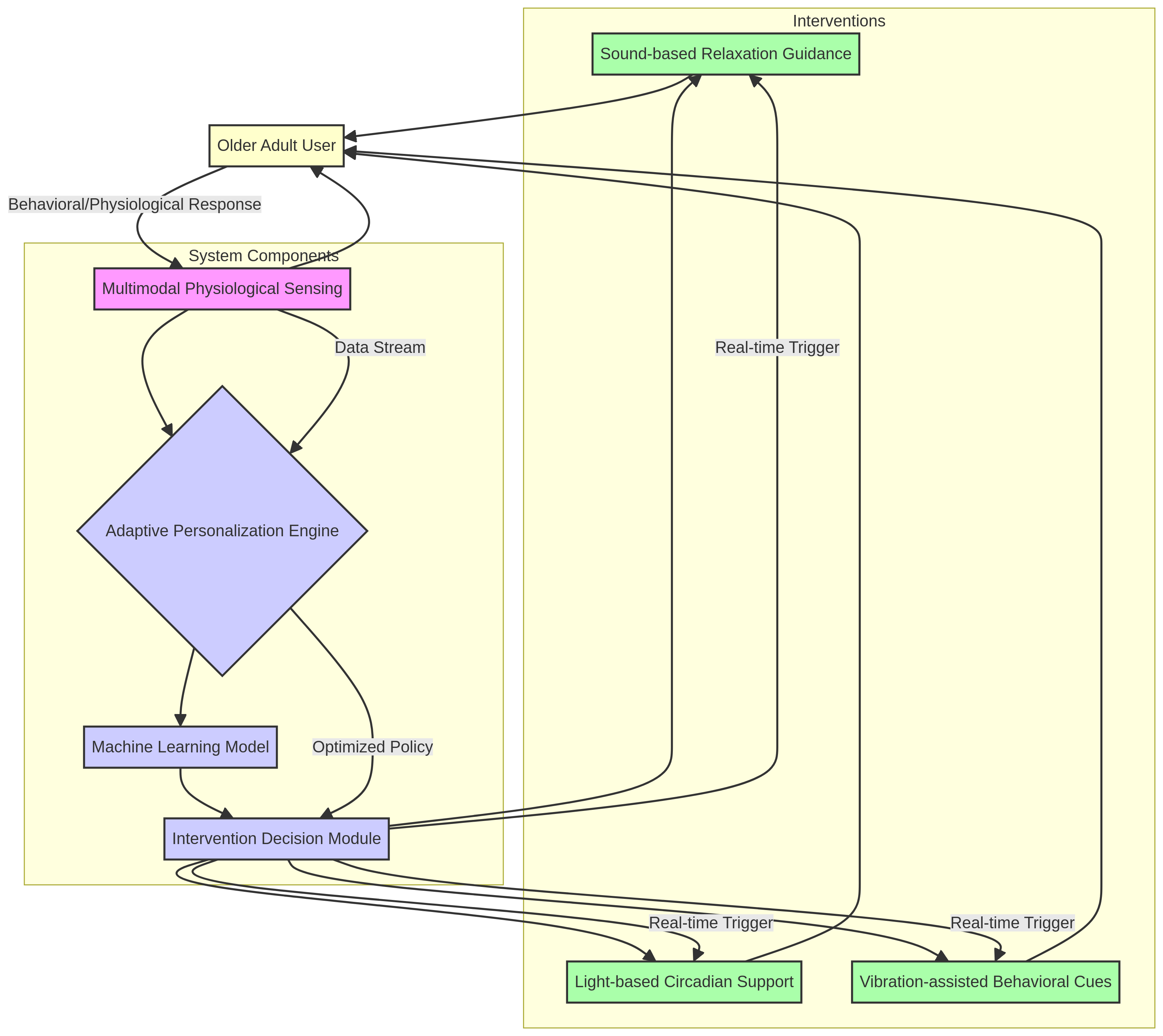
Sleep disturbances are common among older adults and contribute to declines in health, cognition, and overall well-being. To address the limitations of passive, monitoring-centered digital sleep solutions, this study proposes a design-driven smart wearable system that integrates multimodal physiological sensing, adaptive personalization, and non-pharmacological behavioral and sensory-based interventions. A randomized crossover trial involving 40 older adults demonstrated that activation of the personalized intervention module — including sound-based relaxation guidance, light-based circadian support, and vibration-assisted behavioral cues — led to significant improvements in both subjective and objective sleep outcomes. Participants experienced a mean reduction of 2.2 points in Pittsburgh Sleep Quality Index (PSQI) scores, alongside improvements in sleep efficiency, wake after sleep onset, and sleep fragmentation. A subsample undergoing home-based polysomnography (PSG) showed moderate to strong correlations between wearable-derived and PSG-derived sleep parameters (r = 0.68–0.79), supporting the physiological validity of the system. High adherence and usability ratings further indicated that design-driven personalization effectively enhanced engagement, a key barrier in conventional wearable-based sleep interventions. These findings suggest that adaptive, non-pharmacological wearable interventions can provide a scalable and accessible approach to precision sleep health management in aging populations.
Downloads
Downloads
Published
Versions
- 2026-01-23 (2)
- 2025-12-09 (1)
How to Cite
Issue
Section
Categories
License
Copyright (c) 2025 BIG.D

This work is licensed under a Creative Commons Attribution-NonCommercial-NoDerivatives 4.0 International License.