
Self-Powered Triboelectric Pressure Sensor Array Integrated Smart Insole for Gait Monitoring and Rehabilitation Training: A Wearable Bionic System Mimicking Plantar Mechanoreceptors
DOI:
https://doi.org/10.64504/big.d.v2i4.300Abstract
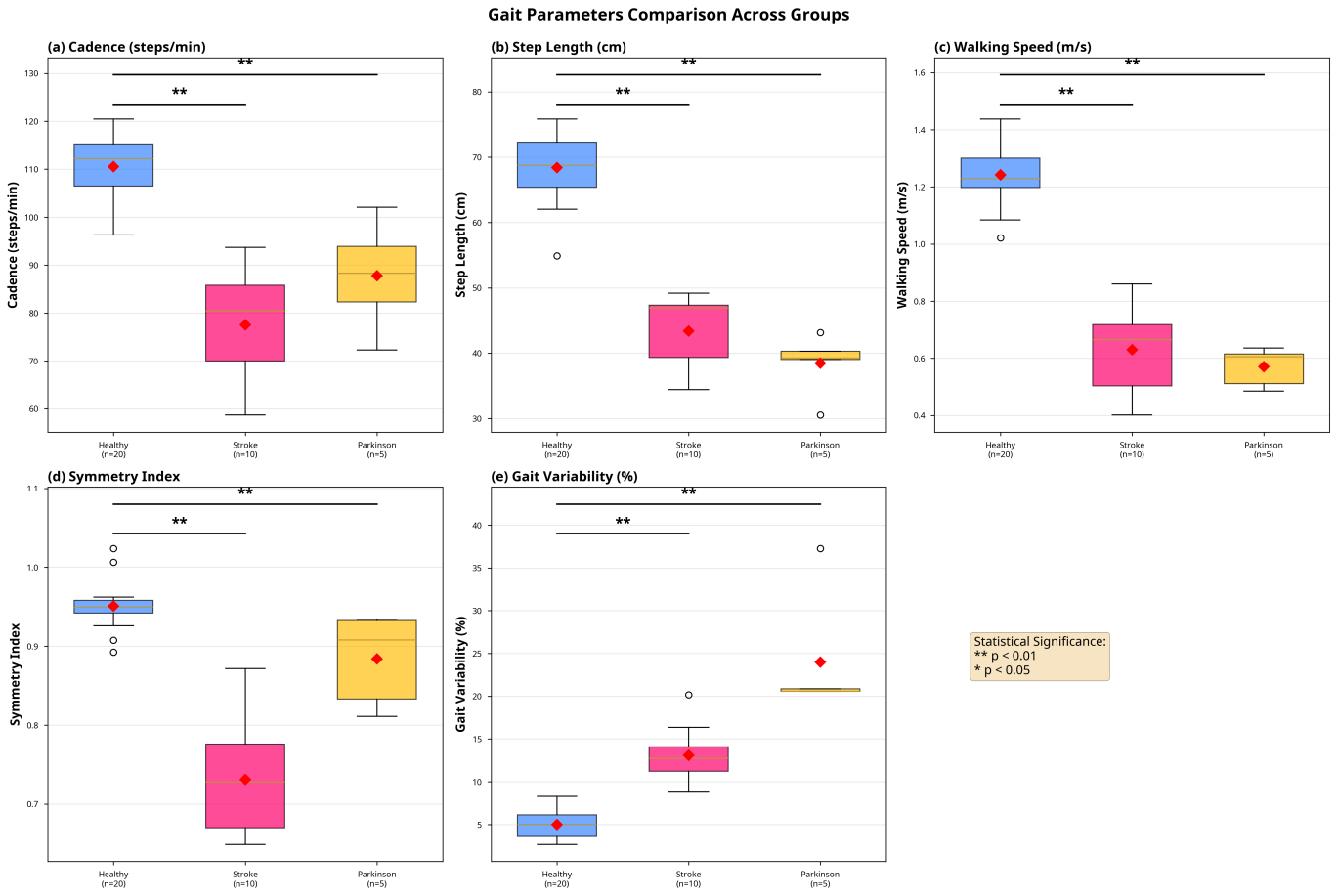
Gait impairment resulting from neurological disorders such as stroke and Parkinson's disease presents a significant challenge to patient mobility and quality of life, creating an urgent demand for continuous and objective gait monitoring in rehabilitation. However, existing commercial systems are often limited by their reliance on external power sources, low sensor density, and a lack of real-time intelligent feedback. To address these limitations, this paper presents a self-powered, wireless smart insole system based on a triboelectric nanogenerator (TENG) for real-time gait monitoring and rehabilitation training. To strengthen the theoretical foundation, we establish a dynamic Schottky contact–triboelectric coupling mechanism, where the PEDOT:PSS/Ti interface forms a pressure-dependent Schottky barrier. Variations in the barrier height modulate charge transfer efficiency, quantitatively explaining the sensor’s dual-sensitivity characteristics (0–100 kPa: 0.42 kPa⁻¹; 100–500 kPa: 0.18 kPa⁻¹). The PEDOT:PSS microstructure enhances local contact electrification and electron mobility, thereby increasing triboelectric output. A 16-channel bio-inspired pressure sensor array is fabricated using a conductive textile coated with PEDOT:PSS. High-resolution plantar pressure data is wirelessly transmitted and analyzed by a hybrid Support Vector Machine (SVM)–Convolutional Neural Network (CNN) model. Experimental design incorporates multi-batch sensor fabrication, cross-operator data acquisition, and power analysis–supported sample size justification to improve reproducibility. Our results demonstrate a rapid response time (<50 ms), excellent durability (>100,000 cycles), and a peak harvested power of 3.5 mW. The hybrid model achieves a gait classification accuracy of 96.8%. Clinical validation with 15 patients and 20 controls showed significant improvements in gait parameters after four weeks of training. This work provides a low-cost, wearable, and intelligent solution for personalized rehabilitation, bridging the gap between triboelectric theory, sensor design, and clinical application.
Downloads
Downloads
Published
Versions
- 2026-05-08 (3)
- 2026-01-23 (2)
- 2025-12-09 (1)
How to Cite
Issue
Section
Categories
License
Copyright (c) 2025 BIG.D

This work is licensed under a Creative Commons Attribution-NonCommercial-NoDerivatives 4.0 International License.