
Digital Participatory Surveillance for Identifying Geographic Disparities in Childhood Malnutrition Risk: A Multi-Scale Spatial Analysis
DOI:
https://doi.org/10.64504/big.d.v3i4.1093Keywords:
Childhood Malnutrition, Digital Surveillance, Spatial Analysis, Health Disparities, Small Area EstimationAbstract
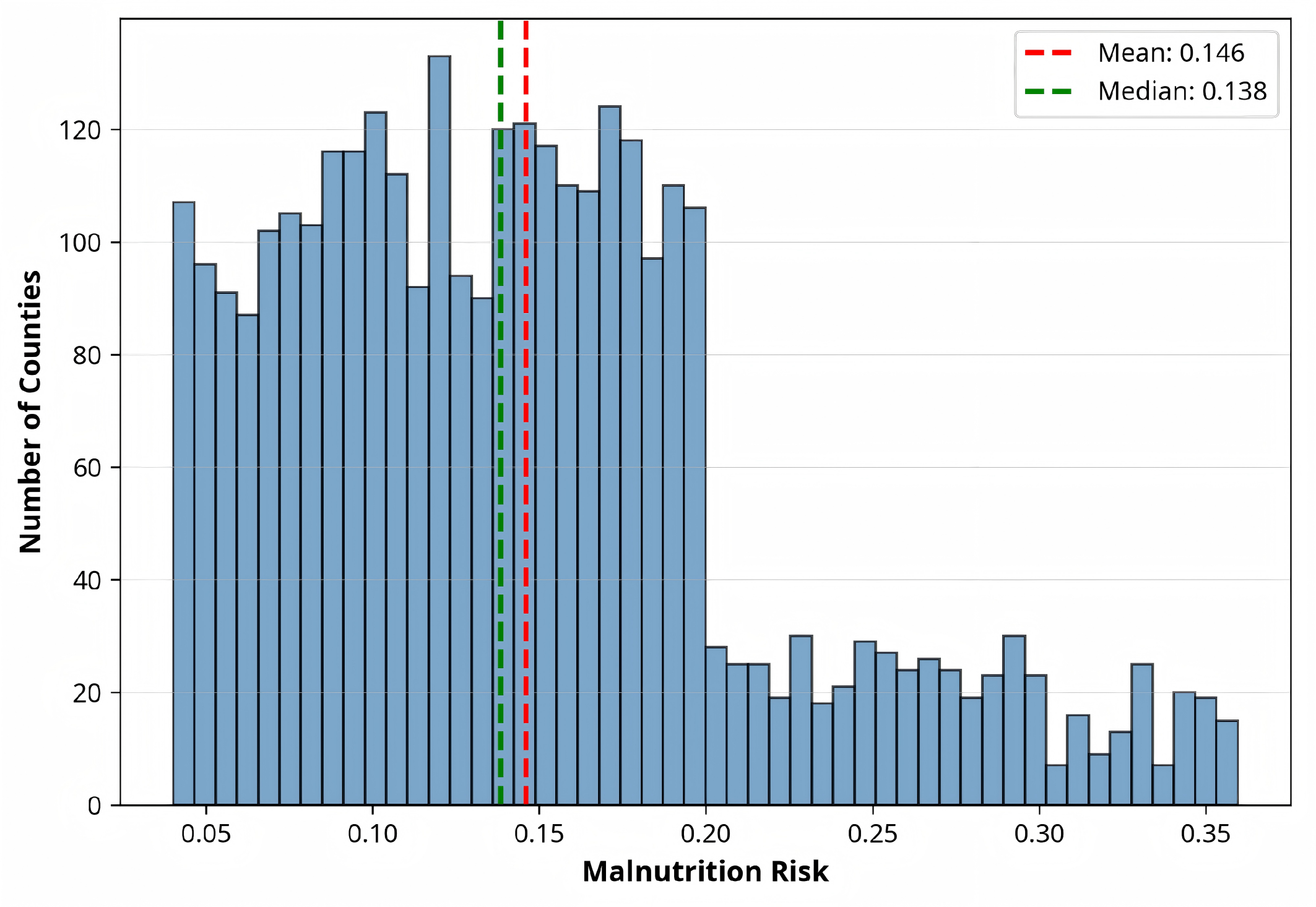
Childhood malnutrition remains a critical global health challenge, with profound and lasting impacts on individual development and societal well-being. Traditional surveillance methods, often reliant on infrequent national surveys, lack the granularity and timeliness needed to guide targeted public health interventions. This study addresses the urgent need for high-resolution, dynamic data on childhood nutritional status. We leveraged a digital participatory surveillance platform, NutriTrack, to collect real-time nutritional data from parents and guardians of children under five years of age across the United States between July 2024 and June 2025. Applying advanced Small Area Estimation (SAE) models, we generated granular, county-level estimates of malnutrition risk (stunting and wasting). Spatial clustering analysis was then employed to identify statistically significant hotspots of high malnutrition risk. Based on a nationally representative sample of 55,820 children, the survey-weighted estimate for malnutrition risk was 15.2% (95% confidence interval [CI]: 14.5%–15.9%). We uncovered substantial geographic heterogeneity, with county-level rates varying from 4.0% to 36.0%. Spatial analysis revealed significant clustering of high-risk counties, particularly in the rural Southeast and parts of the Southwest, forming distinct malnutrition hotspots that are largely invisible in national-level data. Our findings demonstrate that digital participatory surveillance, combined with advanced spatial analytics, can effectively identify and map childhood malnutrition disparities at a fine geographic scale, providing a powerful tool for public health authorities to move towards precise, data-driven interventions.
Downloads
References
[1]Victora, C. G., Adair, L., Fall, C., Hallal, P. C., Martorell, R., Richter, L., & Sachdev, H. S. (2008). Maternal and child undernutrition: consequences for adult health and human capital. The lancet, 371(9609), 340-357.https://doi.org/10.1016/S0140-6736(07)61692-4
[2]De Onis, M., & Branca, F. (2016). Childhood stunting: a global perspective. Maternal & child nutrition, 12, 12-26.https://doi.org/10.1111/mcn.12231
[3]Swinburn, B. A., Kraak, V. I., Allender, S., Atkins, V. J., Baker, P. I., Bogard, J. R., ... & Dietz, W. H. (2019). The global syndemic of obesity, undernutrition, and climate change: the Lancet Commission report. The lancet, 393(10173), 791-846.https://doi.org/10.1016/S0140-6736(18)32822-8
[4]Grantham-McGregor, S., Cheung, Y. B., Cueto, S., Glewwe, P., Richter, L., & Strupp, B. (2007). Developmental potential in the first 5 years for children in developing countries. The lancet, 369(9555), 60-70.https://doi.org/10.1016/S0140-6736(07)60032-4
[5]Black, R. E., Victora, C. G., Walker, S. P., Bhutta, Z. A., Christian, P., De Onis, M., ... & Uauy, R. (2013). Maternal and child undernutrition and overweight in low-income and middle-income countries. The lancet, 382(9890), 427-451.https://doi.org/10.1016/S0140-6736(13)60937-X
[6]Brown, J. L., & Pollitt, E. (1996). Malnutrition, poverty and intellectual development. Scientific American, 274(2), 38-43.https://doi.org/10.1038/scientificamerican0296-38
[7]National Center for Health Statistics. (2021). National Health and Nutrition Examination Survey (NHANES). Centers for Disease Control and Prevention.
[8]Krieger, N., Chen, J. T., Waterman, P. D., Soobader, M. J., Subramanian, S. V., & Carson, R. (2002). Geocoding and monitoring of US socioeconomic inequalities in mortality and cancer incidence: does the choice of area-based measure and geographic level matter? the Public Health Disparities Geocoding Project. American journal of epidemiology, 156(5), 471-482. https://doi.org/10.1093/aje/kwf068
[9]Dwyer-Lindgren, L., Squires, E. R., Teeple, S., Ikilezi, G., Allen Roberts, D., Colombara, D. V., ... & Lim, S. S. (2018). Small area estimation of under-5 mortality in Bangladesh, Cameroon, Chad, Mozambique, Uganda, and Zambia using spatially misaligned data. Population Health Metrics, 16(1), 13.https://doi.org/10.1186/s12963-018-0171-7
[10]Béné, C. (2020). Resilience of local food systems and links to food security–A review of some important concepts in the context of COVID-19 and other shocks: Béné C. Food security, 12(4), 805-822.https://doi.org/10.1007/s12571-020-01076-1
[11]Ogden, C. L., Carroll, M. D., Kit, B. K., & Flegal, K. M. (2014). Prevalence of childhood and adult obesity in the United States, 2011-2012. Jama, 311(8).doi:10.1001/jama.2014.732
[12]Dietz, W. H., & Baur, L. A. (2022). The prevention of childhood obesity. Clinical obesity in adults and children, 323-338.https://doi.org/10.1002/9781119695257.ch25
[13]Rao, J. N., & Molina, I. (2015). Small area estimation. John Wiley & Sons.
[14]Pfeffermann, D. (2013). New important developments in small area estimation. Statistical science, 40-68.https://doi.org/10.1214/12-STS395
[15]Park, D. K., Gelman, A., & Bafumi, J. (2004). Bayesian multilevel estimation with poststratification: State-level estimates from national polls. Political Analysis, 12(4), 375-385. https://doi.org/10.1093/pan/mph024
[16]Maiti, T. (2005). Bayesian aspects of small area estimation. Handbook of statistics, 25, 965-982.https://doi.org/10.1016/S0169-7161(05)25034-4
[17]Jones, M., & Huh, J. (2014). Toward a multidimensional understanding of residential neighborhood: a latent profile analysis of Los Angeles neighborhoods and longitudinal adult excess weight. Health & place, 27, 134-141.https://doi.org/10.1016/j.healthplace.2014.01.011
[18]Hales, C. M. (2020). Prevalence of Obesity and Severe Obesity Among Adults:. US Department of Health and Human Services, Centers for Disease Control and Prevention, National Center for Health Statistics.
[19]Wójcik, O. P., Brownstein, J. S., Chunara, R., & Johansson, M. A. (2014). Public health for the people: participatory infectious disease surveillance in the digital age. Emerging themes in epidemiology, 11(1), 7.https://doi.org/10.1186/1742-7622-11-7
[20]Paolotti, D., Carnahan, A., Colizza, V., Eames, K., Edmunds, J., Gomes, G., ... & Vespignani, A. (2014). Web‐based participatory surveillance of infectious diseases: the Influenzanet participatory surveillance experience. Clinical Microbiology and Infection, 20(1), 17-21. https://doi.org/10.1111/1469-0691.12477
[21]Smolinski, M. S., Crawley, A. W., Baltrusaitis, K., Chunara, R., Olsen, J. M., Wójcik, O., ... & Brownstein, J. S. (2015). Flu near you: crowdsourced symptom reporting spanning 2 influenza seasons. American journal of public health, 105(10), 2124-2130.https://doi.org/10.2105/AJPH.2015.302696
[22]Thompson, F. E., & Subar, A. F. (2017). Dietary assessment methodology. Nutrition in the Prevention and Treatment of Disease, 5-48.https://doi.org/10.1016/B978-0-12-802928-2.00001-1
[23]World Health Organization. (2017). Training Course on Child Growth Assessment. Geneva, WHO, 2008. Cited Here.
[24]Gelman, A., & Hill, J. (2007). Data analysis using regression and multilevel/hierarchical models. Cambridge university press.
[25]Singh, G. K., Siahpush, M., & Kogan, M. D. (2010). Neighborhood socioeconomic conditions, built environments, and childhood obesity. Health affairs, 29(3), 503-512.https://doi.org/10.1377/hlthaff.2009.0730
[26]Pan, L., Blanck, H. M., Sherry, B., Dalenius, K., & Grummer-Strawn, L. M. (2012). Trends in the prevalence of extreme obesity among US preschool-aged children living in low-income families, 1998-2010. Jama, 308(24), 2563-2565.doi:10.1001/jama.2012.108099
[27]Braveman, P., & Gottlieb, L. (2014). The social determinants of health: it's time to consider the causes of the causes. Public health reports, 129(1_suppl2), 19-31.https://doi.org/10.1177/00333549141291S206
[28]Larson, N. I., Story, M. T., & Nelson, M. C. (2009). Neighborhood environments: disparities in access to healthy foods in the US. American journal of preventive medicine, 36(1), 74-81.https://doi.org/10.1016/j.amepre.2008.09.025
[29]Coleman-Jensen, A., Rabbitt, M. P., Gregory, C. A., & Singh, A. (2020). Household Food Security in the United States in 2019. USDA Economic Research Service.
[30]Brownstein, J. S., Freifeld, C. C., & Madoff, L. C. (2009). Digital disease detection—harnessing the Web for public health surveillance. The New England journal of medicine, 360(21), 2153.doi: 10.1056/NEJMp0900702
[31]Chunara, R., Goldstein, E., Patterson-Lomba, O., & Brownstein, J. S. (2015). Estimating influenza attack rates in the United States using a participatory cohort. Scientific reports, 5(1), 9540.https://doi.org/10.1038/srep09540
Downloads
Published
How to Cite
Issue
Section
Categories
License
Copyright (c) 2026 Big.D

This work is licensed under a Creative Commons Attribution-NonCommercial-NoDerivatives 4.0 International License.