
Deep Learning-Optimized Virtual Reality Interface Design for Anxiety and Depression Treatment: A Patient- Centered Medical Device Innovation
DOI:
https://doi.org/10.64504/big.d.v3i4.1101Abstract
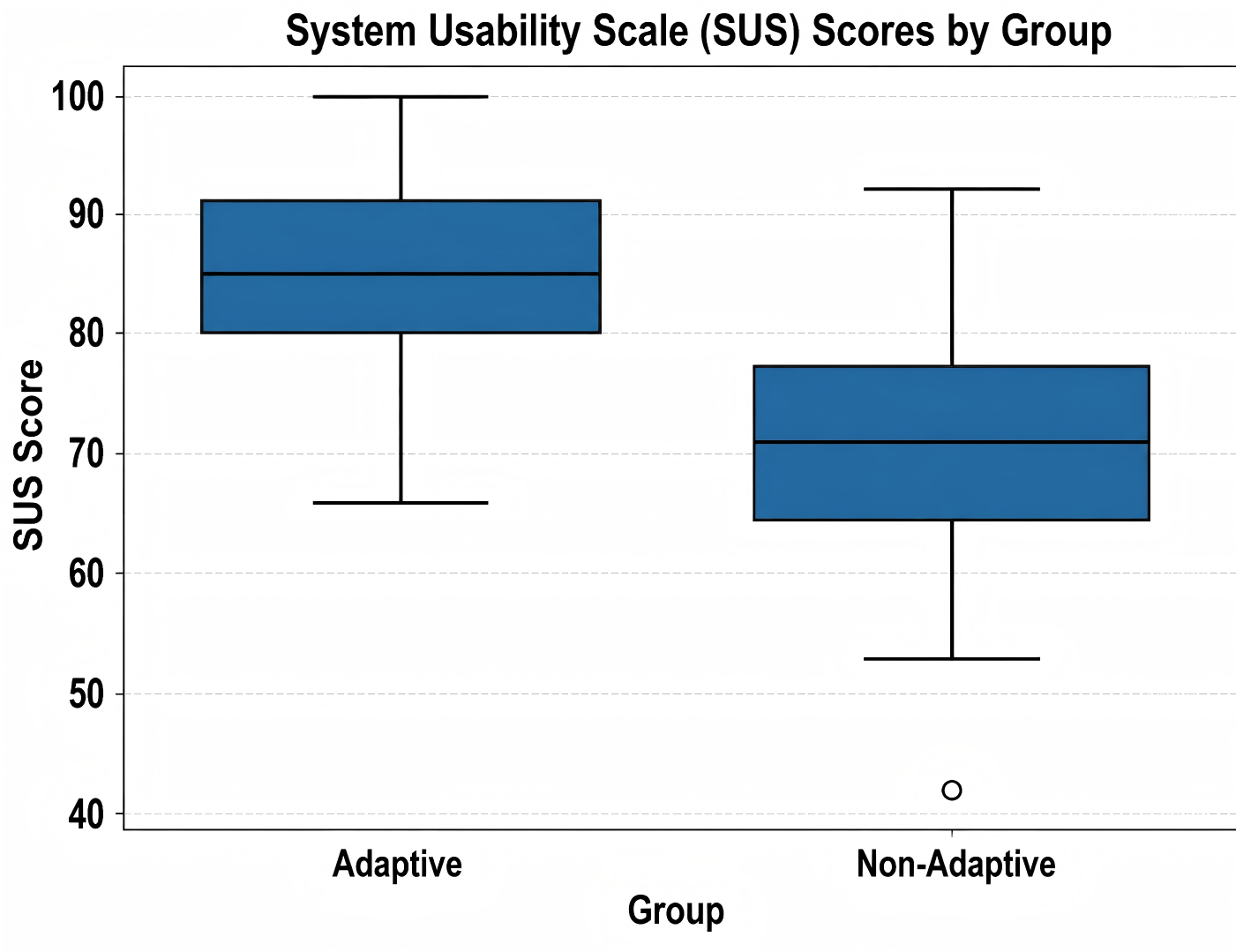
Anxiety and depression treatment is constrained by variable adherence and limited personalization in static virtual-reality (VR) protocols. This study developed a patient-centered VR therapeutic system that integrates physiological and behavioral sensing with a deep Q-learning (DQL) adaptive interface. EEG, heart rate, galvanic skin response, gaze, and movement data were converted into a real-time state representation to regulate environmental stimuli within a clinically tolerable exposure range. In a 12-week randomized controlled trial involving 120 participants, Adaptive VRT produced lower week-12 HAMA scores than Non-Adaptive VRT (12.03±5.65 vs. 17.93±5.42, p<0.001) and lower HAMD scores (12.45±5.85 vs. 15.98±5.33, p=0.002). The Adaptive group also reported higher usability (SUS: 85.74±7.87 vs. 70.67±10.29) and completed more sessions (11.45±0.50 vs. 9.62±1.08; both p<0.001). The results demonstrate the clinical and human-factors value of closed-loop, patient-centered VR adaptation for anxiety and depression treatment.
Downloads
References
[1]World Health Organization, “Mental health: Strengthening our response,” 2022. [Online]. Available: https://www.who.int/news-room/fact-sheets/detail/mental-health-strengthening-our-response
[2]A. E. Kazdin, “Addressing the treatment gap: A key challenge for extending evidence-based psychosocial interventions,” Behav. Res. Ther., vol. 88, pp. 7–18, 2017, doi: 10.1016/j.brat.2016.06.004.
[3]W. Zeng, J. Xu, J. Yu, and X. Chu, “Effectiveness of virtual reality therapy in the treatment of anxiety disorders in adolescents and adults: A systematic review and meta-analysis of randomized controlled trials,” Front. Psychiatry, vol. 16, Art. no. 1553290, 2025, doi: 10.3389/fpsyt.2025.1553290.
[4]Y. LeCun, Y. Bengio, and G. Hinton, “Deep learning,” Nature, vol. 521, no. 7553, pp. 436–444, 2015, doi: 10.1038/nature14539.
[5]M. Jiang, J. Huang, and L. Wang, “Adaptive user interfaces for wearable medical devices using deep Q-learning and Golden Jackal Optimization,” Sci. Rep., vol. 15, Art. no. 44776, 2025, doi: 10.1038/s41598-025-28937-z.
[6]J. Wu, Y. Sun, G. Zhang, Z. Zhou, and Z. Ren, “Virtual reality-assisted cognitive behavioral therapy for anxiety disorders: A systematic review and meta-analysis,” Front. Psychiatry, vol. 12, Art. no. 575094, 2021, doi: 10.3389/fpsyt.2021.575094.
[7]T. Horigome, S. Kurokawa, K. Sawada, S. Kudo, K. Shiga, M. Mimura, and T. Kishimoto, “Virtual reality exposure therapy for social anxiety disorder: A systematic review and meta-analysis,” Psychol. Med., vol. 50, no. 15, pp. 2487–2497, 2020, doi: 10.1017/S0033291720003785.
[8]N. Baghaei, V. Chitale, A. Hlasnik, L. Stemmet, H.-N. Liang, and R. Porter, “Virtual reality for supporting the treatment of depression and anxiety: Scoping review,” JMIR Ment. Health, vol. 8, no. 9, e29681, 2021, doi: 10.2196/29681.
[9]S. Shahid, J. Kelson, and A. Saliba, “Effectiveness and user experience of virtual reality for social anxiety disorder: Systematic review,” JMIR Ment. Health, vol. 11, e48916, 2024, doi: 10.2196/48916.
[10]P. Wang, X. Ai, X. Zhang, F. Ma, Y. Zhuang, and S. Wang, “Evaluating virtual reality technology in psychotherapy: Impacts on anxiety, depression, and ADHD,” Front. Psychiatry, vol. 15, Art. no. 1480788, 2024, doi: 10.3389/fpsyt.2024.1480788.
[11]M. Lee et al., “Virtual reality-based cognitive behavior therapy for major depressive disorder: An alternative to pharmacotherapy for reducing suicidality,” Yonsei Med. J., vol. 66, no. 1, pp. 25–36, 2025, doi: 10.3349/ymj.2024.0002.
[12]Y. Pu and H. Luo, “Using virtual reality technology to treat adolescent and young adult depression disorder: A systematic review and meta-analysis,” Discover Psychol., vol. 5, no. 1, Art. no. 58, 2025, doi: 10.1007/s44202-025-00384-x.
[13]D. Freeman et al., “Automated virtual reality therapy to treat agoraphobic avoidance and distress in patients with psychosis (gameChange): A multicentre, parallel-group, single-blind, randomised, controlled trial in England with mediation and moderation analyses,” Lancet Psychiatry, vol. 9, no. 5, pp. 375–388, 2022, doi: 10.1016/S2215-0366(22)00060-8.
[14]T. C. Frommeyer et al., “Reinforcement learning and its clinical applications within healthcare: A systematic review of precision medicine and dynamic treatment regimes,” Healthcare, vol. 13, no. 14, Art. no. 1752, 2025, doi: 10.3390/healthcare13141752.
[15]J. Schmidhuber, “Deep learning in neural networks: An overview,” Neural Netw., vol. 61, pp. 85–117, 2015, doi: 10.1016/j.neunet.2014.09.003.
[16]K. Z. Gajos, J. O. Wobbrock, and D. S. Weld, “Improving the performance of motor-impaired users with automatically-generated, ability-based interfaces,” in Proc. SIGCHI Conf. Hum. Factors Comput. Syst., 2008, pp. 1257–1266, doi: 10.1145/1357054.1357250.
[17]S. Amershi, M. Cakmak, W. B. Knox, and T. Kulesza, “Power to the people: The role of humans in interactive machine learning,” AI Mag., vol. 35, no. 4, pp. 105–120, 2014, doi: 10.1609/aimag.v35i4.2513.
[18]C. J. C. H. Watkins and P. Dayan, “Q-learning,” Mach. Learn., vol. 8, no. 3, pp. 279–292, 1992, doi: 10.1007/BF00992698.
[19]H. L. O’Brien and E. G. Toms, “What is user engagement? A conceptual framework for defining user engagement with technology,” J. Amer. Soc. Inf. Sci. Technol., vol. 59, no. 6, pp. 938–955, 2008, doi: 10.1002/asi.20801.
[20]M. Slater and S. Wilbur, “A framework for immersive virtual environments (FIVE): Speculations on the role of presence in virtual environments,” Presence, vol. 6, no. 6, pp. 603–616, 1997, doi: 10.1162/pres.1997.6.6.603.
[21]S. Barello, G. Graffigna, and E. Vegni, “Patient engagement as an emerging challenge for healthcare services: Mapping the literature,” Nurs. Res. Pract., vol. 2012, Art. no. 905934, 2012, doi: 10.1155/2012/905934.
[22]G. Eysenbach, “What is e-health?” J. Med. Internet Res., vol. 3, no. 2, e20, 2001, doi: 10.2196/jmir.3.2.e20.
[23]S. R. Steinhubl, E. D. Muse, and E. J. Topol, “Can mobile health technologies transform health care?” JAMA, vol. 310, no. 22, pp. 2395–2396, 2013, doi: 10.1001/jama.2013.281078.
[24]R. W. Picard, Affective Computing. Cambridge, MA, USA: MIT Press, 2000.
[25]X. Chen, M. Cao, H. Wei, Z. Shang, and L. Zhang, “Patient emotion recognition in human–computer interaction system based on machine learning method and interactive design theory,” J. Med. Imaging Health Inform., vol. 11, no. 2, pp. 307–312, 2021, doi: 10.1166/jmihi.2021.3293.
[26]E. S. Bordin, “The generalizability of the psychoanalytic concept of the working alliance,” Psychother.: Theory, Res. Pract., vol. 16, no. 3, p. 252, 1979, doi: 10.1037/h0085885.
[27]A. Miloff, P. Carlbring, W. Hamilton, G. Andersson, L. Reuterskiöld, and P. Lindner, “Measuring alliance toward embodied virtual therapists in the era of automated treatments with the Virtual Therapist Alliance Scale (VTAS): Development and psychometric evaluation,” J. Med. Internet Res., vol. 22, no. 3, e16660, 2020, doi: 10.2196/16660.
[28]P. R. Montague, R. J. Dolan, K. J. Friston, and P. Dayan, “Computational psychiatry,” Trends Cogn. Sci., vol. 16, no. 1, pp. 72–80, 2012, doi: 10.1016/j.tics.2011.11.018.
[29]Z. Azizi et al., “Challenge of optimizing medical therapy in heart failure: Unlocking the potential of digital health and patient engagement,” J. Amer. Heart Assoc., vol. 13, no. 2, e030952, 2024, doi: 10.1161/JAHA.123.030952.
[30]N. Chopra and M. M. Ansari, “Golden jackal optimization: A novel nature-inspired optimizer for engineering applications,” Expert Syst. Appl., vol. 198, Art. no. 116924, 2022, doi: 10.1016/j.eswa.2022.116924.
Downloads
Published
How to Cite
Issue
Section
Categories
License
Copyright (c) 2026 Big.D

This work is licensed under a Creative Commons Attribution-NonCommercial-NoDerivatives 4.0 International License.