
Artificial Intelligence-Driven Iterative Design Framework for Optimizing User Experience in Medical Device Interfaces: A Cross-Disciplinary Empirical Study
DOI:
https://doi.org/10.64504/big.d.v3i4.1106Abstract
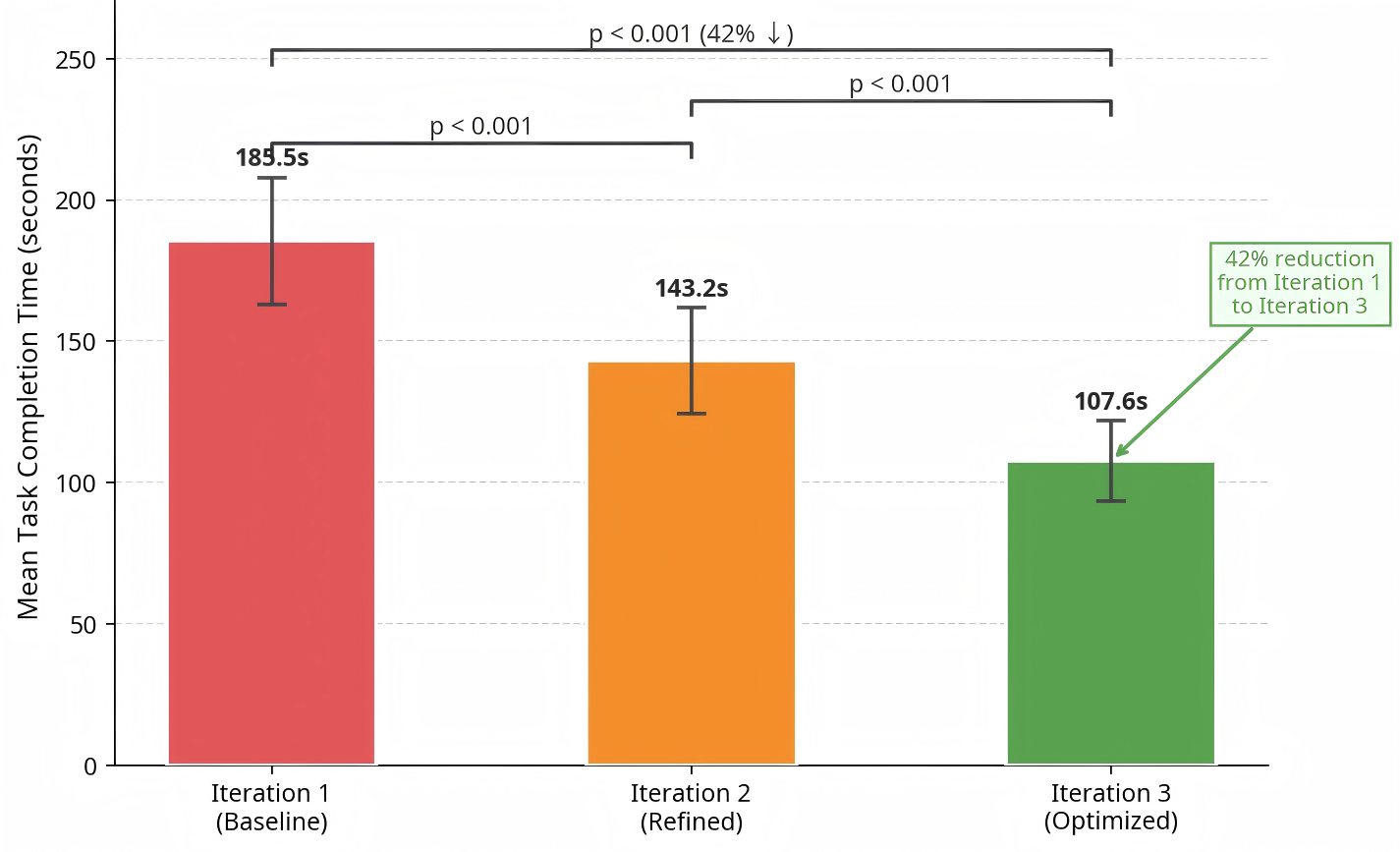
The increasing complexity of medical devices presents significant challenges to user interface (UI) design, directly impacting clinical efficiency and patient safety. Traditional design methodologies often struggle to keep pace with technological advancements and fail to adequately integrate user-centered principles, resulting in suboptimal user experiences. To address this gap, this study introduces and validates an Artificial Intelligence-Driven Iterative Design Framework (AIDF), a novel approach that synergizes machine learning, eye-tracking technology, and design innovation to systematically enhance the usability of medical device interfaces. The research involved an empirical study with 128 participants, including medical professionals and patients, who interacted with different UI prototypes of a simulated infusion pump. By leveraging a Convolutional Neural Network (CNN) to analyze eye-tracking data, the AIDF identified critical usability bottlenecks and generated data-driven design recommendations. The results demonstrate that the application of the AIDF led to a 42% reduction in task completion time, a 58% decrease in error rates, and a 35% improvement in user satisfaction scores compared to conventional design methods. These findings underscore the profound potential of integrating artificial intelligence into the design process, offering a robust, efficient, and scalable methodology for creating safer and more intuitive medical devices. This research provides a significant theoretical contribution to the field of human-computer interaction and offers practical guidance for the medical device industry, paving the way for next-generation, user-centric healthcare technologies.
Downloads
References
[1]World Health Organization. (2016). Global strategy on human resources for health: workforce 2030. World Health Organization.
[2]Donaldson, M. S., Corrigan, J. M., & Kohn, L. T. (Eds.). (2000). To err is human: building a safer health system. https://doi.org/10.17226/9728.
[3]Zhang, J., Patel, V. L., & Johnson, T. R. (2002). Medical error: is the solution medical or cognitive?. Journal of the American Medical Informatics Association, 9(Supplement_6), S75-S77.https://doi.org/10.1197/jamia.M1232
[4]U.S. Food and Drug Administration. (n.d.). Human factors and medical devices. Center for Devices and Radiological Health. Retrieved from https://www.fda.gov/medical-devices/device-advice-comprehensive-regulatory-assistance/human-factors-and-medical-devices
[5]Brown, T. (2008). Design thinking. Harvard business review, 86(6), 84.
[6]Abras, C., Maloney-Krichmar, D., & Preece, J. (2004). User-centered design. Bainbridge, W. Encyclopedia of Human-Computer Interaction. Thousand Oaks: Sage Publications, 37(4), 445-456.
[7]Anantrasirichai, N., & Bull, D. (2022). Artificial intelligence in the creative industries: a review. Artificial intelligence review, 55(1), 589-656.
[8]Duchowski, A. T., & Duchowski, A. T. (2017). Eye tracking methodology: Theory and practice. Springer.
[9]Boden, M. A. (2009). Computer models of creativity. Ai Magazine, 30(3), 23-23.
[10]Goldberg, J. H., & Helfman, J. I. (2010, April). Comparing information graphics: a critical look at eye tracking. In Proceedings of the 3rd BELIV'10 Workshop: BEyond time and errors: novel evaLuation methods for Information Visualization (pp. 71-78).https://doi.org/10.1145/2110192.2110203
[11]Norman, D. (2013). The design of everyday things: Revised and expanded edition. Basic books.
[12]Sweller, J. (1988). Cognitive load during problem solving: Effects on learning. Cognitive science, 12(2), 257-285.https://doi.org/10.1016/0364-0213(88)90023-7
[13]Razzouk, R., & Shute, V. (2012). What is design thinking and why is it important?. Review of educational research, 82(3), 330-348.https://doi.org/10.3102/0034654312457429
[14]Goodman, E., & Kuniavsky, M. (2012). Observing the user experience: A practitioner's guide to user research. Elsevier.
[15]Brooke, J. (1996). SUS-A quick and dirty usability scale. Usability evaluation in industry, 189(194), 4-7.
[16]Hart, S. G., & Staveland, L. E. (1988). Development of NASA-TLX (Task Load Index): Results of empirical and theoretical research. In Advances in psychology (Vol. 52, pp. 139-183). North-holland.https://doi.org/10.1016/S0166-4115(08)62386-9
[17]D'mello, S. K., & Kory, J. (2015). A review and meta-analysis of multimodal affect detection systems. ACM computing surveys (CSUR), 47(3), 1-36.https://doi.org/10.1145/2682899
[18]Guo, Y., Liu, Y., Georgiou, T., & Lew, M. S. (2018). A review of semantic segmentation using deep neural networks. International journal of multimedia information retrieval, 7(2), 87-93.
Downloads
Published
How to Cite
Issue
Section
Categories
License
Copyright (c) 2026 Big.D

This work is licensed under a Creative Commons Attribution-NonCommercial-NoDerivatives 4.0 International License.