
A Mixed-Methods Analysis of Digital Health Engagement for Chronic Disease Management in Low- and Middle-Income Countries
DOI:
https://doi.org/10.64504/big.d.v3i4.1112Abstract
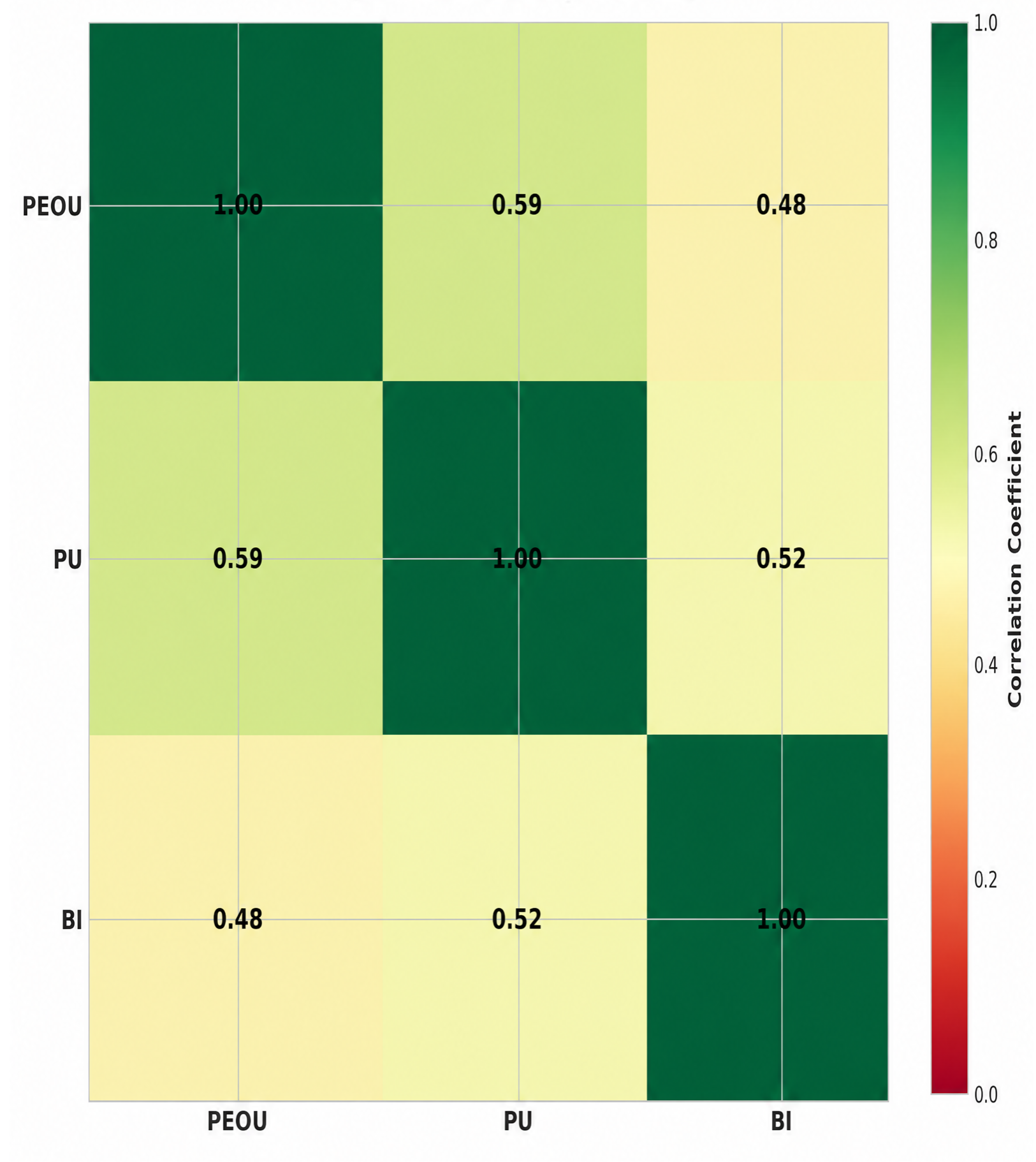
Chronic disease management in low- and middle-income countries requires digital interventions that remain usable under constrained infrastructure. This sequential explanatory mixed-methods study examined engagement with a chronic-care platform among 528 adults with hypertension and/or type 2 diabetes across three LMIC settings, followed by 35 semi-structured interviews. Structural equation modeling quantified Technology Acceptance Model constructs, and CFIR-guided thematic analysis explained the observed patterns. Perceived usefulness (β = 0.45, p < 0.001) and perceived ease of use (β = 0.38, p < 0.001) predicted behavioral intention; ease of use also increased perceived usefulness (β = 0.59, p < 0.001), with 62% of intention variance explained. Interviews identified connectivity, power, data cost, digital literacy, family support, self-entered-data review, and provider feedback as decisive implementation conditions. The findings support offline-capable, low-literacy, human-supported digital health architectures for equitable chronic disease care.
Downloads
References
[1]World Health Organization, “Noncommunicable diseases,” Fact sheet, Sep. 2023. [Online]. Available: https://www.who.int/news-room/fact-sheets/detail/noncommunicable-diseases
[2]L. N. Allen, S. Wigley, H. Holmer, and P. Barlow, “Non-communicable disease policy implementation from 2014 to 2021: A repeated cross-sectional analysis of global policy data for 194 countries,” Lancet Global Health, vol. 11, no. 4, pp. e525–e533, 2023, doi: 10.1016/S2214-109X(23)00042-6.
[3]World Health Organization, Global Strategy on Digital Health 2020–2025. Geneva, Switzerland: WHO, 2021. [Online]. Available: https://www.who.int/publications/i/item/9789240020924
[4]A. Makri, “Bridging the digital divide in health care,” Lancet Digital Health, vol. 1, no. 5, pp. e204–e205, 2019, doi: 10.1016/S2589-7500(19)30111-6.
[5]H. Ibrahim, X. Liu, N. Zariffa, A. D. Morris, and A. K. Denniston, “Health data poverty: An assailable barrier to equitable digital health care,” Lancet Digital Health, vol. 3, no. 4, pp. e260–e265, 2021, doi: 10.1016/S2589-7500(20)30317-4.
[6]S. Xiong et al., “Digital health interventions for non-communicable disease management in primary health care in low- and middle-income countries,” npj Digit. Med., vol. 6, no. 1, Art. no. 12, 2023, doi: 10.1038/s41746-023-00764-4.
[7]K. Bobrow et al., “Mobile phone text messages to support treatment adherence in adults with high blood pressure (SMS-Text Adherence Support [StAR]): A single-blind, randomized trial,” Circulation, vol. 133, no. 6, pp. 592–600, 2016, doi: 10.1161/CIRCULATIONAHA.115.017530.
[8]K. Stokes, B. Oronti, F. P. Cappuccio, and L. Pecchia, “Use of technology to prevent, detect, manage and control hypertension in sub-Saharan Africa: A systematic review,” BMJ Open, vol. 12, no. 4, Art. no. e058840, 2022, doi: 10.1136/bmjopen-2021-058840.
[9]A. Ramachandran et al., “Effectiveness of mobile phone messaging in prevention of type 2 diabetes by lifestyle modification in men in India: A prospective, parallel-group, randomised controlled trial,” Lancet Diabetes Endocrinol., vol. 1, no. 3, pp. 191–198, 2013, doi: 10.1016/S2213-8587(13)70067-6.
[10]B. Jeffrey et al., “Mobile phone applications and their use in the self-management of type 2 diabetes mellitus: A qualitative study among app users and non-app users,” Diabetol. Metab. Syndr., vol. 11, Art. no. 84, 2019, doi: 10.1186/s13098-019-0480-4.
[11]S. S. Kaboré et al., “Barriers and facilitators for the sustainability of digital health interventions in low and middle-income countries: A systematic review,” Front. Digit. Health, vol. 4, Art. no. 1014375, 2022, doi: 10.3389/fdgth.2022.1014375.
[12]A. A. AlQudah, M. Al-Emran, and K. Shaalan, “Technology acceptance in healthcare: A systematic review,” Appl. Sci., vol. 11, no. 22, Art. no. 10537, 2021, doi: 10.3390/app112210537.
[13]F. D. Davis, “Perceived usefulness, perceived ease of use, and user acceptance of information technology,” MIS Q., vol. 13, no. 3, pp. 319–340, 1989, doi: 10.2307/249008.
[14]V. Venkatesh, M. G. Morris, G. B. Davis, and F. D. Davis, “User acceptance of information technology: Toward a unified view,” MIS Q., vol. 27, no. 3, pp. 425–478, 2003, doi: 10.2307/30036540.
[15]L. J. Damschroder, C. M. Reardon, M. A. O. Widerquist, and J. Lowery, “The updated Consolidated Framework for Implementation Research based on user feedback,” Implement. Sci., vol. 17, no. 1, Art. no. 75, 2022, doi: 10.1186/s13012-022-01245-0.
[16]J. Li, A. Talaei-Khoei, H. Seale, P. Ray, and C. R. MacIntyre, “Health care provider adoption of eHealth: Systematic literature review,” Interact. J. Med. Res., vol. 2, no. 1, Art. no. e7, 2013, doi: 10.2196/ijmr.2468.
[17]J. W. Creswell and V. L. Plano Clark, Designing and Conducting Mixed Methods Research, 3rd ed. Thousand Oaks, CA, USA: SAGE, 2017.
[18]V. Braun and V. Clarke, “Using thematic analysis in psychology,” Qual. Res. Psychol., vol. 3, no. 2, pp. 77–101, 2006, doi: 10.1191/1478088706qp063oa.
[19]C. Pong, R. M. W. W. Tseng, Y. C. Tham, and E. Lum, “Current implementation of digital health in chronic disease management: Scoping review,” J. Med. Internet Res., vol. 26, Art. no. e53576, 2024, doi: 10.2196/53576.
[20]R. J. Holden and B.-T. Karsh, “The technology acceptance model: Its past and its future in health care,” J. Biomed. Inform., vol. 43, no. 1, pp. 159–172, 2010, doi: 10.1016/j.jbi.2009.07.002.
[21]C. Duckworth et al., “Characterising user engagement with mHealth for chronic disease self-management and impact on machine learning performance,” npj Digit. Med., vol. 7, no. 1, Art. no. 66, 2024, doi: 10.1038/s41746-024-01063-2.
[22]J. J. Nathan et al., “Scaling digital health in low- and middle-income countries: Lessons from Malaysia’s cross-sector capacity-building approach,” J. Glob. Health, vol. 15, Art. no. 03044, 2025, doi: 10.7189/jogh.15.03044.
[23]B. Sylla, O. Ismaila, and G. Diallo, “25 years of digital health toward universal health coverage in low- and middle-income countries: Rapid systematic review,” J. Med. Internet Res., vol. 27, Art. no. e59042, 2025, doi: 10.2196/59042.
[24]A. B. Labrique et al., “Best practices in scaling digital health in low and middle income countries,” Glob. Health, vol. 14, no. 1, Art. no. 103, 2018, doi: 10.1186/s12992-018-0424-z.
[25]A.-M. Rosland, M. Heisler, H. J. Choi, M. J. Silveira, and J. D. Piette, “Family influences on self-management among functionally independent adults with diabetes or heart failure: Do family members hinder as much as they help?” Chronic Illn., vol. 6, no. 1, pp. 22–33, 2010, doi: 10.1177/1742395309354608.
Downloads
Published
How to Cite
Issue
Section
Categories
License
Copyright (c) 2026 Big.D

This work is licensed under a Creative Commons Attribution-NonCommercial-NoDerivatives 4.0 International License.