
Systematic Review and Meta-Analysis of Digital Learning Tools for Cognitive Decline in Older Adults
DOI:
https://doi.org/10.64504/big.d.v3i4.1115Abstract
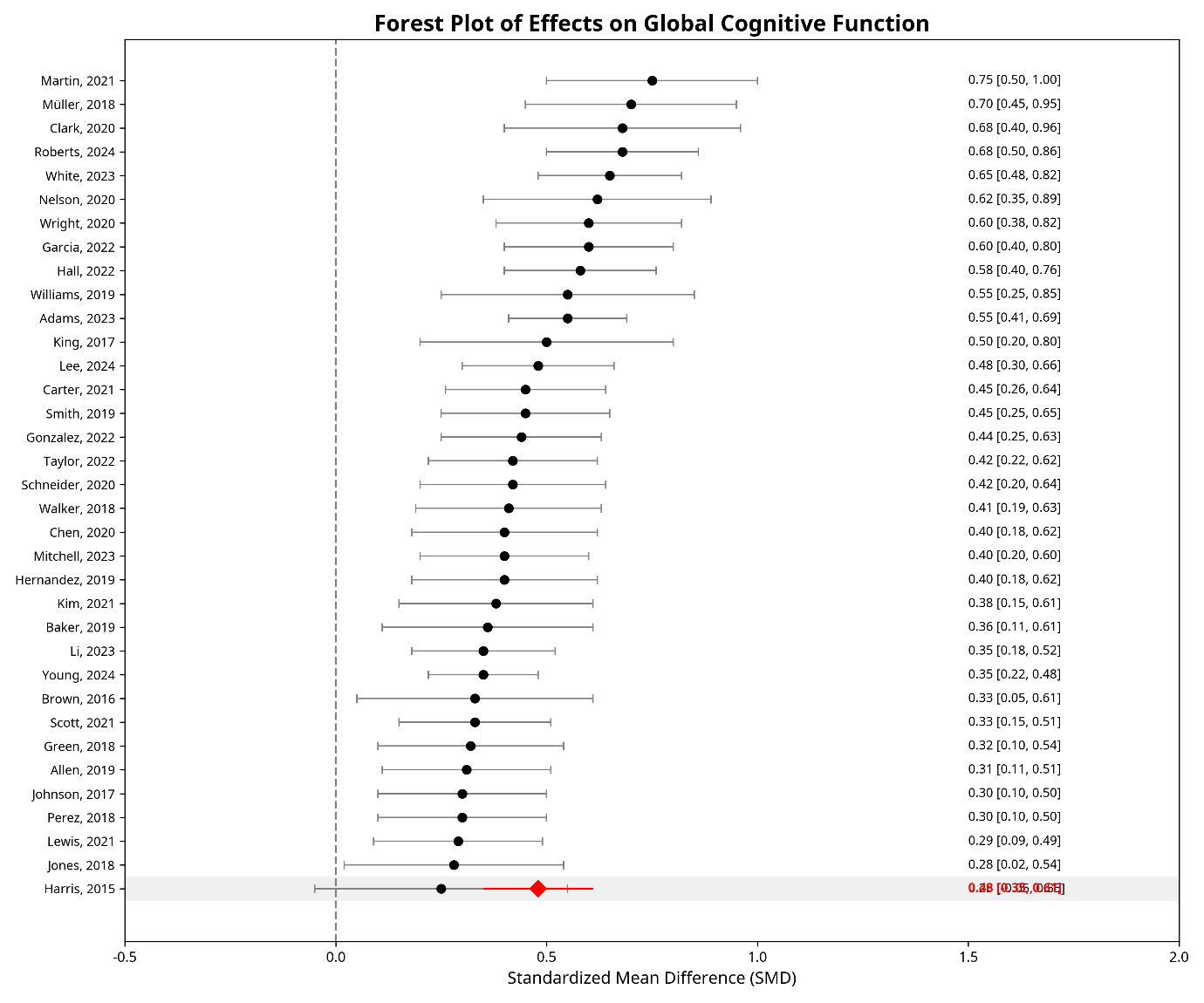
Background: Age-related cognitive decline represents a growing public health challenge, and digital learning tools have emerged as potentially scalable approaches for cognitive support in older adults. However, the overall effectiveness of these interventions and the factors associated with treatment response remain uncertain. This systematic review and meta-analysis aimed to evaluate the effects of digital learning tools on global cognitive function in adults aged 60 years and older and to explore potential moderators of intervention effects. Methods: Five electronic databases (PubMed, Embase, PsycINFO, Cochrane CENTRAL, and Web of Science) were searched for randomized controlled trials evaluating digital learning interventions in older adults with or without mild cognitive impairment (MCI). Random-effects models were used to synthesize standardized mean differences (SMDs) for global cognitive outcomes. Exploratory subgroup analyses examined intervention modality, participant cognitive status, intervention dosage, and risk of bias. The certainty of evidence was assessed using the GRADE framework. Results: Thirty-five randomized controlled trials involving 4,288 participants were included. Digital learning interventions were associated with improved global cognitive performance compared with control conditions (SMD = 0.48, 95% CI 0.35–0.61), although substantial heterogeneity was observed (I2 = 78%). Exploratory analyses indicated larger effect estimates for virtual reality-based interventions (SMD = 0.65) and serious games (SMD = 0.54) compared with computerized cognitive training (SMD = 0.39). Greater effects were also observed among participants with MCI (SMD = 0.56) and studies providing at least 24 hours of intervention exposure (SMD = 0.59). However, the certainty of evidence was rated as very low because of methodological limitations, substantial inconsistency, and potential small-study effects. Conclusion: Digital learning tools show potential for supporting cognitive performance in older adults, but current evidence remains insufficient to establish definitive effectiveness or identify optimal intervention characteristics. Future research should prioritize well-designed randomized trials with standardized outcomes, longer follow-up periods, transparent reporting, and evaluation of feasibility, accessibility, and real-world cognitive benefits.
Downloads
References
[1]World Health Organization. (2021). Ageing and health. Retrieved from https://www.who.int/news-room/fact-sheets/detail/ageing-and-health
[2]Livingston, G., Huntley, J., Sommerlad, A., Ames, D., Ballard, C., Banerjee, S., ... & Mukadam, N. (2020). Dementia prevention, intervention, and care: 2020 report of the Lancet Commission. The lancet, 396(10248), 413-446.https://doi.org/10.1016/S0140-6736(20)30367-6
[3]Nichols, E., Steinmetz, J. D., Vollset, S. E., Fukutaki, K., Chalek, J., Abd-Allah, F., ... & Liu, X. (2022). Estimation of the global prevalence of dementia in 2019 and forecasted prevalence in 2050: an analysis for the Global Burden of Disease Study 2019. The Lancet Public Health, 7(2), e105-e125.https://doi.org/10.1016/S2468-2667(21)00249-8
[4]World Health Organization. (2019). Global action plan on the public health response to dementia 2017–2025. Retrieved from https://www.who.int/publications/i/item/9789241513487
[5]Knapp, M., Prince, M., & Albanese, E. (2007). Dementia UK: The full report. Alzheimer’s Society.
[6]Torous, J., & Hsin, H. (2018). Empowering the digital therapeutic relationship: virtual clinics for digital health interventions. NPJ digital medicine, 1(1), 16.https://doi.org/10.1038/s41746-018-0028-2
[7]Chan, A. T., Ip, R. T., Tran, J. Y., Chan, J. Y., & Tsoi, K. K. (2024). Computerized cognitive training for memory functions in mild cognitive impairment or dementia: a systematic review and meta-analysis. NPJ digital medicine, 7(1), 1.https://doi.org/10.1038/s41746-023-00987-5
[8]Benge, J. F., & Scullin, M. K. (2025). A meta-analysis of technology use and cognitive aging. Nature human behaviour, 9(7), 1405-1419.https://doi.org/10.1038/s41562-025-02159-9
[9]Lin, X., Xu, G., Zhao, M., & Jiang, Y. (2025). Efficacy of different digital interventions in patients with mild cognitive impairment or dementia: A systematic review and network meta-analysis. International Journal of Nursing Studies, 169, 105129.https://doi.org/10.1016/j.ijnurstu.2025.105129
[10]Chen, C., Huang, N., Hu, B., Zhang, M., Yuan, J., & Guo, J. (2025). The effectiveness of digital technology interventions for cognitive function in older adults: a systematic review and meta-analysis of randomized controlled trials. Geroscience, 47(1), 653-683.https://doi.org/10.1007/s11357-024-01446-z
[11]Di Lorito, C., Bosco, A., Rai, H., Craven, M., McNally, D., Todd, C., ... & Harwood, R. H. (2022). A systematic literature review and meta‐analysis on digital health interventions for people living with dementia and Mild Cognitive Impairment. International journal of geriatric psychiatry, 37(6).https://doi.org/10.1002/gps.5730
[12]Gao, Y., & Liu, N. (2025). Effects of digital technology-based serious games interventions for older adults with mild cognitive impairment: a meta-analysis of randomised controlled trials. Age and Ageing, 54(4), afaf080.https://doi.org/10.1093/ageing/afaf080
[13]Lampit, A., Hallock, H., & Valenzuela, M. (2014). Computerized cognitive training in cognitively healthy older adults: a systematic review and meta-analysis of effect modifiers. PLoS medicine, 11(11), e1001756.https://doi.org/10.1371/journal.pmed.1001756
[14]Zhong, D., Chen, L., Feng, Y., Song, R., Huang, L., Liu, J., & Zhang, L. (2021). Effects of virtual reality cognitive training in individuals with mild cognitive impairment: a systematic review and meta‐analysis. International Journal of Geriatric Psychiatry, 36(12), 1829-1847. https://doi.org/10.1002/gps.5603
[15]Bonvino, A., Cornacchia, E., Scaramuzzi, G. F., Gasparre, D., Manippa, V., Rivolta, D., & Taurisano, P. (2025). Digital tools for mild cognitive impairment: a systematic review and meta-analysis of diagnostic accuracy and methodological challenges. Neuropsychology Review, 1-13.https://doi.org/10.1007/s11065-025-09680-8
[16]Page, M. J., McKenzie, J. E., Bossuyt, P. M., Boutron, I., Hoffmann, T. C., Mulrow, C. D., ... & Moher, D. (2021). The PRISMA 2020 statement: an updated guideline for reporting systematic reviews. bmj, 372. https://doi.org/10.1136/bmj.n71
[17]Sterne, J. A., Savović, J., Page, M. J., Elbers, R. G., Blencowe, N. S., Boutron, I., ... & Higgins, J. P. (2019). RoB 2: a revised tool for assessing risk of bias in randomised trials. bmj, 366. https://doi.org/10.1136/bmj.l4898
[18]Cohen, J. (2013). Statistical power analysis for the behavioral sciences. routledge.
[19]Stern, Y. (2012). Cognitive reserve in ageing and Alzheimer’s disease. The Lancet Neurology, 11(11), 1006-1012.https://doi.org/10.1016/S1474-4422(12)70191-6
[20]Simons, D. J., Boot, W. R., Charness, N., Gathercole, S. E., Chabris, C. F., Hambrick, D. Z., & Stine-Morrow, E. A. (2016). Do “brain-training” programs work?. Psychological science in the public interest, 17(3), 103-186.
Downloads
Published
How to Cite
Issue
Section
Categories
License
Copyright (c) 2026 Big.D

This work is licensed under a Creative Commons Attribution-NonCommercial-NoDerivatives 4.0 International License.