
Passive and Continuous Assessment of Motor Function Recovery in Post-Stroke Rehabilitation using Wearable Sensors and Deep Learning
DOI:
https://doi.org/10.64504/big.d.v3i4.1118Abstract
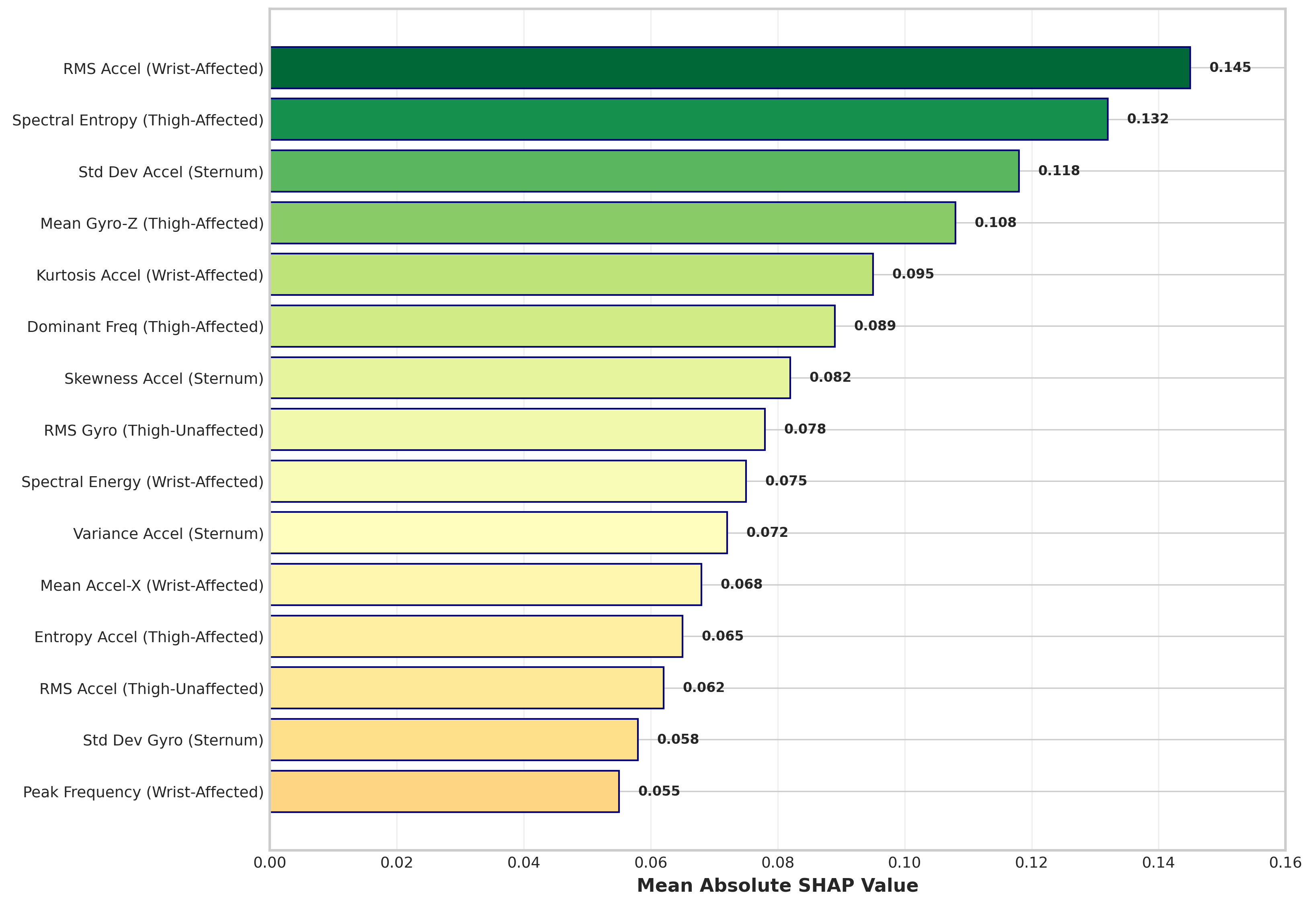
Continuous assessment of motor recovery remains challenging in post-stroke rehabilitation because conventional clinical evaluations are intermittent and labor-intensive. This study proposes a passive longitudinal monitoring framework that integrates wearable inertial measurement units (IMUs) with a CNN-LSTM model to predict motor function at the subsequent clinical assessment. Eighty-five stroke patients were enrolled, and complete longitudinal data from 77 participants were analyzed. Seven IMUs were used during 7-day home-monitoring periods, and temporal kinematic features were extracted to predict the subsequent Fugl–Meyer Assessment (FMA) score. A sensor-combination optimization strategy was further conducted to identify a practical wearable configuration, while SHAP analysis was employed to improve model interpretability. Experimental results demonstrated that the proposed model achieved an R² of 0.92, MAE of 2.85, and RMSE of 3.41 FMA points on the test set. Among 127 evaluated sensor combinations, a lightweight three-sensor configuration (sternum, affected wrist, and affected thigh) achieved an RMSE of 3.58, only 0.17 points higher than the full seven-sensor system while substantially reducing hardware complexity. These results demonstrate that the proposed framework enables accurate and interpretable prediction of motor recovery using passive home-monitoring data, providing a practical solution for long-term rehabilitation assessment and wearable healthcare applications.
Downloads
References
[1]Johnson, C. O., Nguyen, M., Roth, G. A., Nichols, E., Alam, T., Abate, D., ... & Miller, T. R. (2019). Global, regional, and national burden of stroke, 1990–2016: a systematic analysis for the Global Burden of Disease Study 2016. The Lancet Neurology, 18(5), 439-458.https://doi.org/10.1016/S1474-4422(19)30034-1
[2]Langhorne, P., Bernhardt, J., & Kwakkel, G. (2011). Stroke rehabilitation. The Lancet, 377(9778), 1693-1702.https://doi.org/10.1016/S0140-6736(11)60325-5
[3]Nakayama, H., Jørgensen, H. S., Raaschou, H. O., & Olsen, T. S. (1994). Recovery of upper extremity function in stroke patients: the Copenhagen Stroke Study. Archives of physical medicine and rehabilitation, 75(4), 394-398.https://doi.org/10.1016/0003-9993(94)90161-9
[4]Patel, S., Park, H., Bonato, P., Chan, L., & Rodgers, M. (2012). A review of wearable sensors and systems with application in rehabilitation. Journal of neuroengineering and rehabilitation, 9(1), 21.https://doi.org/10.1186/1743-0003-9-21
[5]Adans-Dester, C., Hankov, N., O’Brien, A., Vergara-Diaz, G., Black-Schaffer, R., Zafonte, R., ... & Bonato, P. (2020). Enabling precision rehabilitation interventions using wearable sensors and machine learning to track motor recovery. NPJ digital medicine, 3(1), 121.https://doi.org/10.1038/s41746-020-00328-w
[6]Matias, I., Haas, M., Daza, E. J., Kliegel, M., & Wac, K. (2026). Digital biomarkers for brain health: passive and continuous assessment from wearable sensors. npj Digital Medicine.https://doi.org/10.1038/s41746-026-02340-y
[7]LeCun, Y., Bengio, Y., & Hinton, G. (2015). Deep learning. nature, 521(7553), 436-444.https://doi.org/10.1038/nature14539
[8]Sun, Y., Song, Z., Mo, L., Li, B., Liang, F., Yin, M., & Wang, D. (2025). IMU-Based quantitative assessment of stroke from gait. Scientific Reports, 15(1), 9541.https://doi.org/10.1038/s41598-025-94167-y
[9]Brognara, L, Palumbo, P., Grimm, B., & Palmerini, L. (2019). Assessing gait in Parkinson’s disease using wearable motion sensors: a systematic review. Diseases, 7(1), 18. https://doi.org/10.3390/diseases7010018
[10]Parnandi, A., Wade, E., & Matarić, M. (2010, August). Motor function assessment using wearable inertial sensors. In 2010 Annual International Conference of the IEEE Engineering in Medicine and Biology (pp. 86-89). IEEE.https://doi.org/10.1109/IEMBS.2010.5626156
[11]Fell, N., True, H. H., Allen, B., Harris, A., Cho, J., Hu, Z., ... & Salstrand, R. (2019). Functional measurement post-stroke via mobile application and body-worn sensor technology. Mhealth, 5, 47.https://doi.org/10.21037/mhealth.2019.08.11
[12]Zhou, W., Fu, D., Duan, Z., Wang, J., Zhou, L., & Guo, L. (2025). Achieving precision assessment of functional clinical scores for upper extremity using IMU-Based wearable devices and deep learning methods. Journal of NeuroEngineering and Rehabilitation, 22, 84. https://doi.org/10.1186/s12984-025-01625-9
[13]O’Brien, M. K., Lanotte, F., Khazanchi, R., Shin, S. Y., Fanton, M., Lieber, R. L., Ghaffari, R., & Jayaraman, A. (2024). Early prediction of poststroke rehabilitation outcomes using wearable sensors. Physical Therapy, 104(2), pzad183. https://doi.org/10.1093/ptj/pzad183
[14]Zu, W., Huang, X., Xu, T., Du, L., Wang, Y., Wang, L., & Nie, W. (2023). Machine learning in predicting outcomes for stroke patients following rehabilitation treatment: A systematic review. Plos one, 18(6), e0287308.https://doi.org/10.1371/journal.pone.0287308
[15]Hochreiter, S. (1997). Long short-term memory. Neural Computation MIT-Press.https://doi.org/10.1162/neco.1997.9.8.1735
[16]Krizhevsky, A., Sutskever, I., & Hinton, G. E. (2012). Imagenet classification with deep convolutional neural networks. Advances in neural information processing systems, 25.https://doi.org/10.1145/3065386
[17]Mahmoud, Y., Horvath, K., & Zhou, Y. (2025). Deep learning for predicting rehabilitation success: Advancing clinical and patient-reported outcome modeling. Electronics, 14(6), 1082.https://doi.org/10.3390/electronics14061082
[18]Cui, Y. (2024). An efficient approach to sports rehabilitation and outcome prediction using RNN-LSTM. Mobile Networks and Applications, 1-16.https://doi.org/10.1007/s11036-024-02355-3
[19]19Dipietro, L., Eden, U., Teixeira, P., Tirasawasdichai, N., Warinpramote, J., Pundick, S., ... & Wagner, T. (2025). A multi-modal machine learning approach to predict fugl-meyer scores and motor recovery potential in stroke rehabilitation: Toward precision-based therapies. Information sciences, 122564. https://doi.org/10.1016/j.ins.2025.122564
[20]Woelfle, T., Bourguignon, L., Lorscheider, J., Kappos, L., Naegelin, Y., & Jutzeler, C. R. (2023). Wearable sensor technologies to assess motor functions in people with multiple sclerosis: systematic scoping review and perspective. Journal of Medical Internet Research, 25, e44428.https://doi.org/10.2196/44428
[21]Wang, J., Li, C., Zhang, B., Zhang, Y., Shi, L., Wang, X., ... & Xiong, D. (2024). Automatic rehabilitation exercise task assessment of stroke patients based on wearable sensors with a lightweight multichannel 1D-CNN model. Scientific Reports, 14(1), 19204.https://doi.org/10.1038/s41598-024-68204-1
[22]Lundberg, S. M., & Lee, S.-I. (2017). A unified approach to interpreting model predictions. Advances in Neural Information Processing Systems, 30. https://proceedings.neurips.cc/paper_files/paper/2017/hash/8a20a8621978632d76c43dfd28b67767-Abstract.html
[23]Fugl-Meyer, A. R., Jääskö, L., Leyman, I., Olsson, S., & Steglind, S. (1975). A method for evaluation of physical performance. Scand J Rehabil Med, 7(1), 13-31.https://doi.org/10.2340/1650197771331
[24]Hao, J. (2025). Artificial intelligence empowers physical therapy for neurological conditions. Neurological Sciences, 46(10), 5573-5575.https://doi.org/10.1007/s10072-025-08295-4
Downloads
Published
How to Cite
Issue
Section
Categories
License
Copyright (c) 2026 Big.D

This work is licensed under a Creative Commons Attribution-NonCommercial-NoDerivatives 4.0 International License.