
Teacher Perceptions of Pedagogical Barriers Across Traditional and Digital Contexts: A Mixed-Methods Analysis
DOI:
https://doi.org/10.64504/big.d.v3i4.1128Abstract
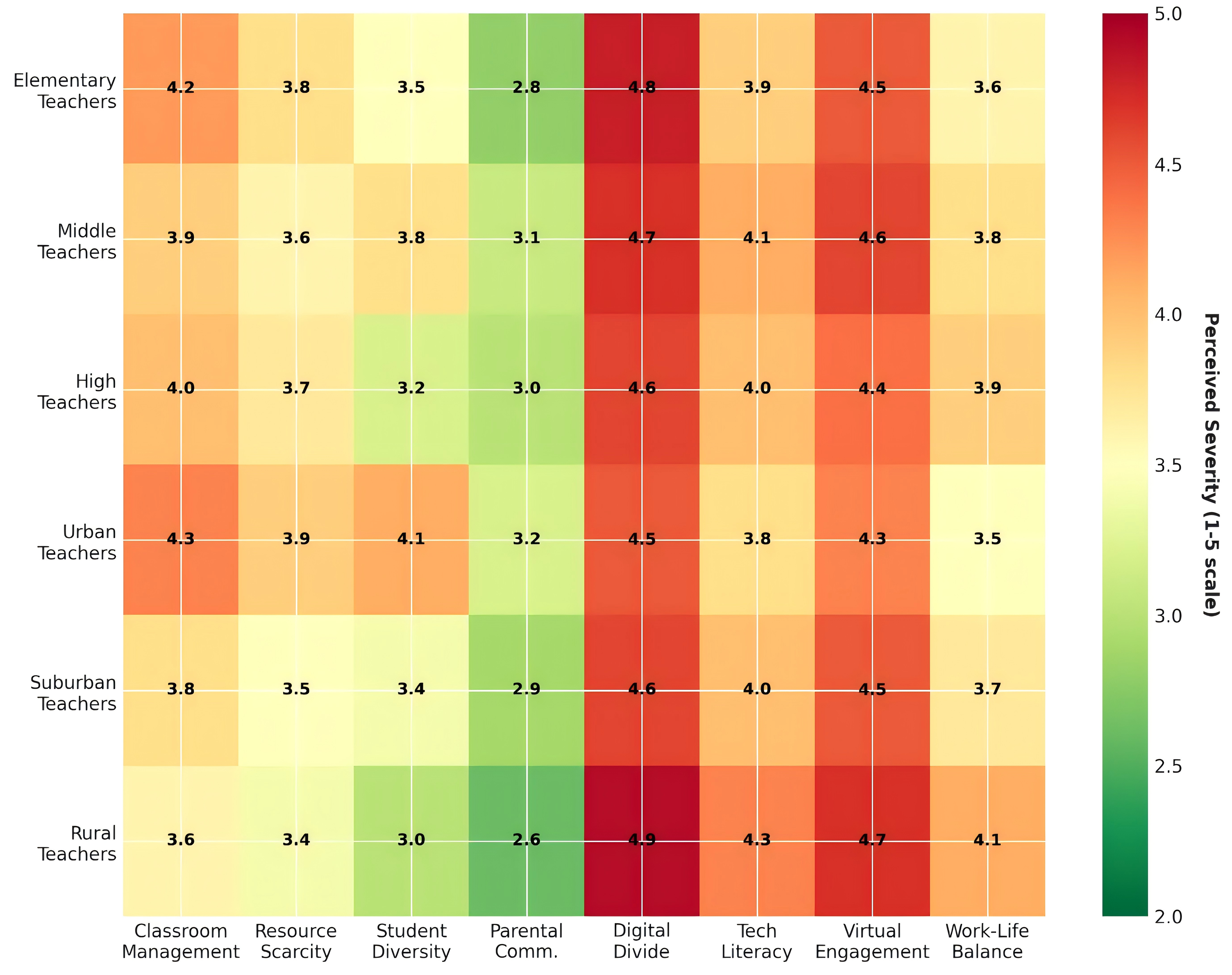
The increasing integration of digital technologies into K–12 education has transformed teaching practices while introducing new pedagogical challenges. This study comparatively examines teachers’ perceived barriers in traditional and digital teaching contexts and identifies how the nature and prevalence of these barriers change across instructional environments. A mixed-methods design was employed with 50 K–12 teachers from urban, suburban, and rural schools in the United States. Data were collected through semi-structured interviews and Likert-scale surveys and analyzed using thematic analysis and descriptive statistics. Eight major barriers were identified. In traditional teaching, classroom management was the most prevalent challenge (84%), followed by resource scarcity (78%), student diversity and differentiation (70%), and parental communication (56%). In digital teaching, the digital divide emerged as the most widespread barrier (94%), followed by virtual student engagement (90%), technological literacy (82%), and work-life balance (76%). Overall, digital barriers were reported more consistently across participants than traditional barriers, indicating that the transition to technology-mediated instruction shifts pedagogical difficulties from predominantly classroom- and resource-related issues toward infrastructural, technological, engagement, and workload-related challenges. These findings demonstrate the need for context-specific teacher support strategies that combine digital infrastructure investment, targeted technology training, engagement-oriented pedagogical development, and measures to protect teacher well-being.
Downloads
References
[1]Stringer, L. R., Lee, K. M., Sturm, S., & Giacaman, N. (2022). A systematic review of primary school teachers’ experiences with digital technologies curricula. Education and Information Technologies, 27(9), 12585-126
[2]Al Mazrooei, A. K., Hatem Almaki, S., Gunda, M., Alnoor, A., & Manji Sulaiman, S. (2022). A systematic review of K–12 education responses to emergency remote teaching during the COVID-19 pandemic. International Review of Education, 68(6), 811-841.07.
[3]Marzano, R. J., & Marzano, J. S. (2003). Classroom management that works: Research-based strategies for every teacher. Ascd.
[4]Gay, G. (2018). Culturally responsive teaching: Theory, research, and practice. teachers college press.
[5]Darling-Hammond, L. (2004). The color line in American education: Race, resources, and student achievement. Du Bois Review: Social Science Research on Race, 1(2), 213-246. https://doi.org/10.1017/S1742058X0404202X
[6]Van Dijk, J. (2020). The Digital Divide. Cambridge: Polity Press. Communication, 2020.
[7]Tondeur, J., Van Braak, J., Ertmer, P. A., & Ottenbreit-Leftwich, A. (2017). Understanding the relationship between teachers’ pedagogical beliefs and technology use in education: A systematic review of qualitative evidence. Educational technology research and development, 65(3), 555-575.https://doi.org/10.1007/s11423-016-9481-2
[8]Means, B., Bakia, M., & Murphy, R. (2014). Learning online: What research tells us about whether, when and how. Routledge.
[9]Reimers, F., & Schleicher, A. (2020). Schooling disrupted, schooling rethought. How the Covid-19 pandemic is changing education.https://doi.org/10.1787/68b11faf-en
[10]Braun, V., & Clarke, V. (2006). Using thematic analysis in psychology. Qualitative research in psychology, 3(2), 77-101. https://doi.org/10.1191/1478088706qp063oa
[11]Kraft, M. A., Blazar, D., & Hogan, D. (2021). The effect of teacher coaching on instruction and achievement. Educational Evaluation and Policy Analysis, 43(4), 540-566. https://doi.org/10.3102 /0034654318759268
[12]Selwyn, N. (2019). Should robots replace teachers?: AI and the future of education. John Wiley & Sons.
Downloads
Published
How to Cite
Issue
Section
Categories
License
Copyright (c) 2026 Big.D

This work is licensed under a Creative Commons Attribution-NonCommercial-NoDerivatives 4.0 International License.