
Autonomous Design Agency in AI-Assisted Architecture: Exploring Intentionality, Ethical Autonomy, and Design Innovation Through Philosophical Pragmatism
DOI:
https://doi.org/10.64504/big.d.v3i3.770Keywords:
AI-assisted architecture; autonomous design agency; generative design; human-AI collaboration; quantitative evaluationAbstract
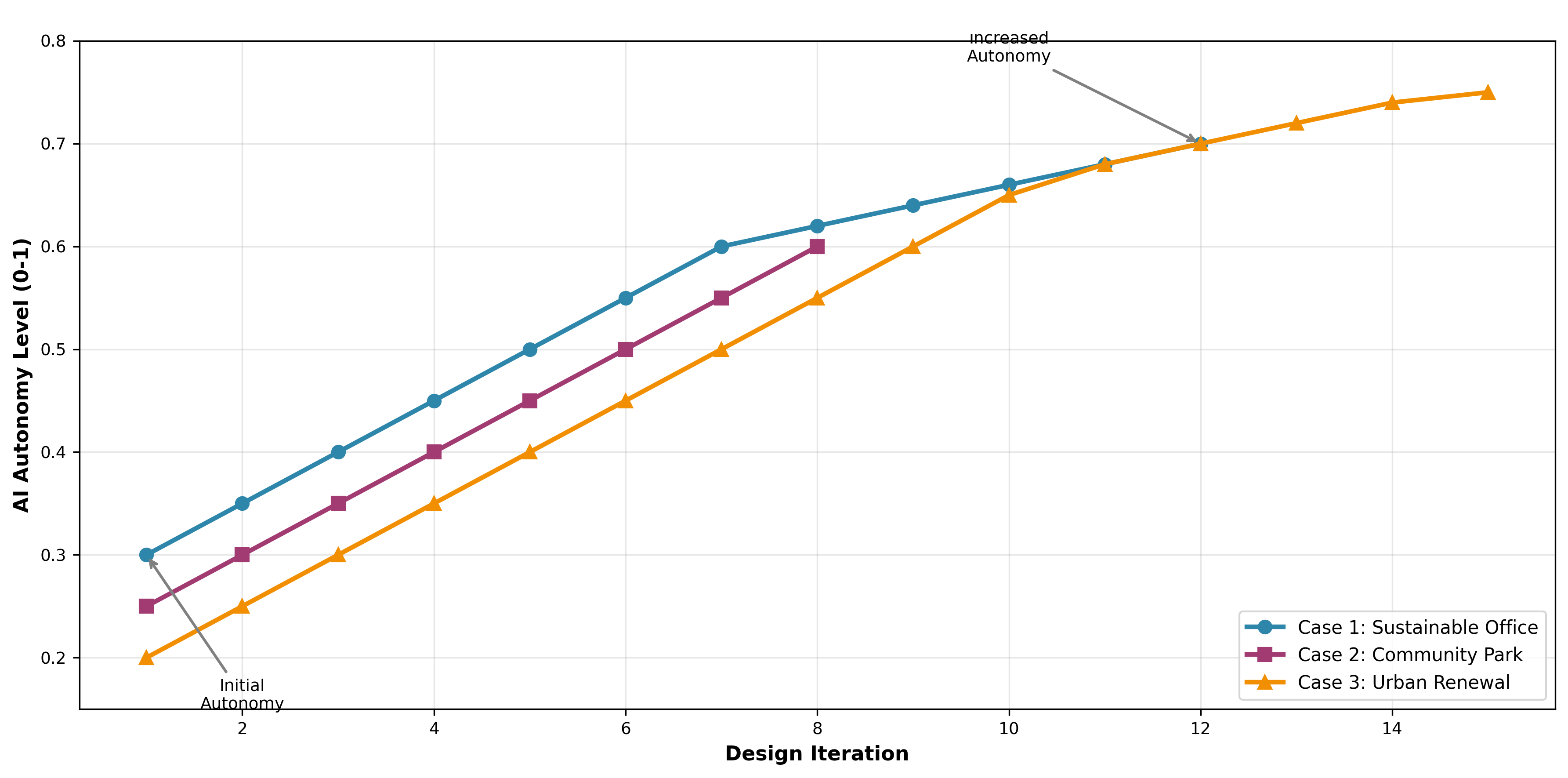
This study reformulates autonomous design agency in AI-assisted architecture as a measurable engineering problem rather than a purely philosophical one. A pragmatist control framework was developed to evaluate how bounded AI autonomy affects design quality, regulatory compliance, and stakeholder acceptance in three completed projects: a sustainable office building, a community park, and an urban renewal district. The dataset combined archived design logs from 35 iterations, site measurement records, interviews with 15 designers, and end-user evaluations from 120 respondents. The method operationalized functional intentionality through goal-directed performance improvement, using an Autonomy Allocation Index, a weighted composite performance score, and project-specific environmental and operational indicators. The results show that higher bounded autonomy was strongly associated with better overall performance (r = 0.921, p < 0.001). In the office case, energy use intensity decreased by 20.3% while daylight factor increased by 59.4%; in the park case, biodiversity increased by 71.9%; and in the renewal case, function integration improved by 58.5% while zoning compliance reached 98%. User satisfaction differed significantly among the three outcomes (F(2,117) = 6.041, p = 0.003). The study provides a reproducible engineering framework for calibrating AI autonomy in architectural workflows without weakening human responsibility.
Downloads
References
[1]Jang, S., Roh, H., & Lee, G. (2025). Generative AI in architectural design: Application, data, and evaluation methods. Automation in Construction, 174, 106174.
[2]Yiannoudes, S. (2025). Shaping architecture with generative artificial intelligence: Deep learning models in architectural design workflow. Architecture, 5(4), 94.
[3]He, W., & Chen, M. (2024). Advancing urban life: A systematic review of emerging technologies and artificial intelligence in urban design and planning. Buildings, 14(3), 835.
[4]Dalsgaard, P. (2014). Pragmatism and Design Thinking. International Journal of design, 8(1).
[5]Schwartz, H. S. (1987). The Reflective Practitioner: How Professionals Think in Action.
[6]Huang, T., Ye, X., Yigitcanlar, T., Xu, B., Newman, G., Zhao, B., ... & Wang, D. (2026). Artificial Intelligence in urban design: A systematic review. Cities, 169, 106527.
[7]Park, C., No, W., Choi, J., & Kim, Y. (2023). Development of an AI advisor for conceptual land use planning. Cities, 138, 104371.
[8]Sönmez, N. O. (2018). A review of the use of examples for automating architectural design tasks. Computer-Aided Design, 96, 13-30.
[9]Wang, L., Liu, J., Zeng, Y., Cheng, G., Hu, H., Hu, J., & Huang, X. (2023). Automated building layout generation using deep learning and graph algorithms. Automation in Construction, 154, 105036.
[10]Zheng, Z., & Petzold, F. (2023). Neural-guided room layout generation with bubble diagram constraints. Automation in construction, 154, 104962.
[11]Aalaei, M., Saadi, M., Rahbar, M., & Ekhlassi, A. (2023). Architectural layout generation using a graph-constrained conditional Generative Adversarial Network (GAN). Automation in Construction, 155, 105053.
[12]Shim, J., Moon, J., Kim, H., & Hwang, E. (2024). FloorDiffusion: Diffusion model-based conditional floorplan image generation method using parameter-efficient fine-tuning and image inpainting. Journal of Building Engineering, 95, 110320.
[13]Karadağ, D., & Ozar, B. (2025). A new frontier in design studio: AI and human collaboration in conceptual design. Frontiers of Architectural Research.
[14]Horvath, A. S., & Pouliou, P. (2024). AI for conceptual architecture: Reflections on designing with text-to-text, text-to-image, and image-to-image generators. Frontiers of Architectural Research, 13(3), 593-612.
[15]Hikmet, Ş., & Ozay, N. (2026). Human–AI Collaboration in Architectural Design Education: Towards a Conceptual Framework. Buildings, 16(6), 1097.
[16]Zhang, Z., Fort, J. M., & Mateu, L. G. (2023). Exploringthe potential of artificial intelligence as a tool for architectural design: A perception study using gaudí’sworks. Buildings, 13(7), 1863.
Downloads
Published
How to Cite
Issue
Section
Categories
License
Copyright (c) 2026 Big.D

This work is licensed under a Creative Commons Attribution-NonCommercial-NoDerivatives 4.0 International License.