
Computational Aesthetics and Philosophical Interpretation of Decorative Pattern Evolution in Ancient Chinese Ceramics: A Multi-Scale Fractal and Semantic Analysis Approach
DOI:
https://doi.org/10.64504/big.d.v3i3.777Keywords:
Computational aesthetics; fractal analysis; Chinese ceramics; cultural heritage; decorative evolution; image processing; visual complexityAbstract
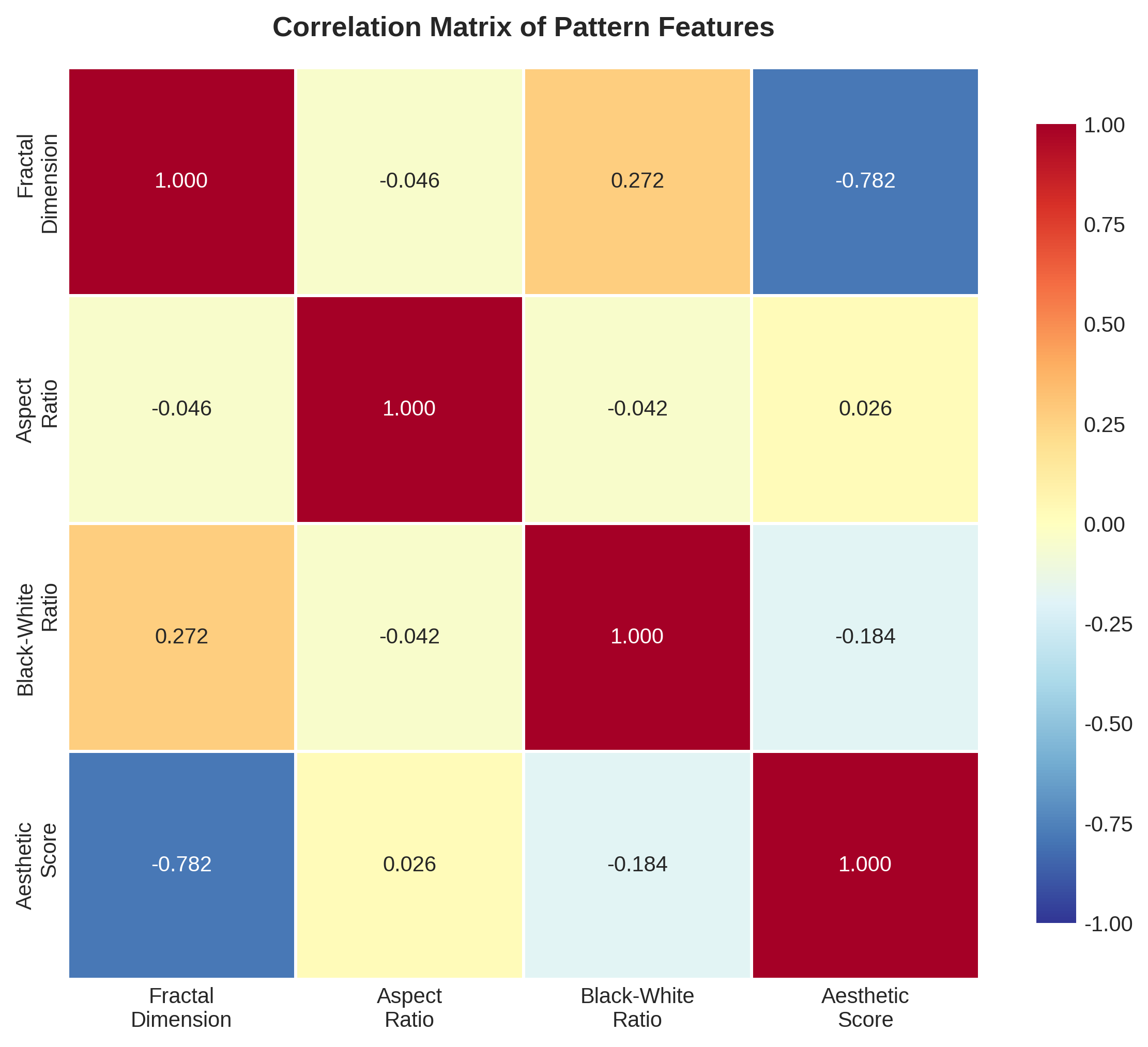
Decorative patterns on ancient Chinese ceramics provide valuable visual evidence for examining historical changes in artistic form, technological practice, and cultural aesthetics. Previous studies of Chinese ceramic decoration have primarily relied on qualitative stylistic description, which limits reproducible comparison across long chronological periods. This study presents an exploratory computational framework for analyzing the formal complexity of ceramic decorative patterns using image-based descriptors and fractal analysis. A dataset of 1,200 ceramic pattern images representing twelve historical periods, from the Yangshao culture to the Qing dynasty, was examined. After grayscale conversion and Otsu thresholding, three visual features were extracted: fractal dimension, aspect ratio, and black-white ratio. These features were used to evaluate temporal changes in pattern complexity and to explore potential stylistic groupings through K-means clustering. The results suggest a general increase in visual complexity from early Neolithic ceramics to later dynastic periods, with higher complexity observed in Tang, Song, Yuan, Ming, and Qing decorative patterns. The clustering results further indicate that image-based complexity measures can distinguish broad stylistic tendencies across historical periods. Rather than claiming a definitive model of aesthetic evolution, this study provides a reproducible computational approach for supporting art-historical interpretation of ceramic decoration. The findings demonstrate the potential of combining computer vision, fractal geometry, and cultural heritage analysis, while also highlighting the need for better-documented datasets and further validation in future research.
Downloads
References
[1]Medley, M. (1976). The Chinese potter: a practical history of Chinese ceramics. (No Title).
[2]Field, E. (1992). Vainker, SJ 1991. Chinese Pottery and Porcelain: from Prehistory to the Present. Papers from the Institute of Archaeology, 3(1).
[3]Sullivan, M. (2008). The Arts of China, Revised and Expanded. Univ of California Press.
[4]Lei, L., & Shouli, Z. (2019, December). Analysis of the relationship between modeling and decoration in ceramic design. In 2019 International Conference on Economic Management and Cultural Industry (ICEMCI 2019) (pp. 868-871). Atlantis Press.
[5]Liming, G., Hongjie, L., & Wilcock, J. (1989). The analysis of ancient Chinese pottery and porcelain shapes: a study of classical profiles from the Yangshao culture to the Qing dynasty using computerized profile data reduction, cluster analysis and fuzzy boundary discrimination. Computer Applications and quantitative methods in Archaeology, 1989, 363-374.
[6]Zhang, J., & Yang, X. (2023). Exploring the archaeological treasures of the silk road: Tibetan arts and crafts, traditional decorative patterns, and pattern symbols analysis. Mediterranean Archaeology and Archaeometry, 23(2), 197-212.
[7]Yang, Y., Shafi, M., Song, X., & Yang, R. (2018). Preservation of cultural heritage embodied in traditional crafts in the developing countries. A case study of Pakistani handicraft industry. Sustainability, 10(5), 1336.
[8]UNESCO. (n.d.). Traditional craftsmanship. Intangible Cultural Heritage. Retrieved from https://ich.unesco.org/en/traditional-craftsmanship-00057
[9]Fazi, M. B. (2018). Contingent computation: abstraction, experience, and indeterminacy in computational aesthetics. Bloomsbury Publishing USA.
[10]Fazi, M. B., & Fuller, M. (2016). Computational aesthetics. A Companion to Digital Art, 281-296.
[11]Douchová, V. (2015). Birkhoff’s aesthetic measure. Acta Universitatis Carolinae Philosophica et Historica, 21(1), 39-53.
[12]Romero, J., Machado, P., Carballal, A., & Correia, J. (2012). Computing aesthetics with image judgement systems. In Computers and creativity (pp. 295-322). Berlin, Heidelberg: Springer Berlin Heidelberg.
[13]Mandelbrot, B. B. (1983). The fractal geometry of nature, Freeman, New York. MandelbrotThe Fractal Geometry of Nature1983.
[14]Brown, C. T., & Witschey, W. R. (2003). The fractal geometry of ancient Maya settlement. Journal of archaeological science, 30(12), 1619-1632.
[15]Ding, M., Zhang, Q., Li, G., Li, W., Chen, F., Wang, Y., ... & Fu, L. (2023). Fractal dimension-based analysis of rockery contour morphological characteristics for Chinese classical gardens south of the Yangtze River. Journal of Asian Architecture and Building Engineering, 22(5), 2490-2505.
[16]Canny, J. (1986). A computational approach to edge detection: IEEE Transactions on Pattern Analysis.
[17]Thangaraj, C., & Easwaramoorthy, D. (2022). Generalized fractal dimensions based comparison analysis of edge detection methods in CT images for estimating the infection of COVID-19 disease. The European Physical Journal Special Topics, 231(18), 3717-3739.
[18]McQueen, J. B. (1967). Some methods of classification and analysis of multivariate observations. In Proc. of 5th Berkeley Symposium on Math. Stat. and Prob. (pp. 281-297).
[19]Arthur, D., & Vassilvitskii, S. (2007, January). k-means++: The advantages of careful seeding. In Soda (Vol. 7, pp. 1027-1035).
[20]Otsu, N. (1975). A threshold selection method from gray-level histograms. Automatica, 11, 285-296.
[21]Andronache, I. (2025). Application of fractal analysis in interpreting 2D and 3D grayscale images: Methodologies and case studies. Journal of the Bulgarian Geographical Society, 52, 157-182.
[22]Toennies, K. D., & Schnabel, J. A. (1994, June). Edge detection using the local fractal dimension. In Proceedings of IEEE Symposium on Computer-Based Medical Systems (CBMS) (pp. 34-39). IEEE.
[23]Heidegger, M. (1963). The origin of the work of art (pp. 44-47). University of Waterloo.
[24]Zangwill, N. (2001). The metaphysics of beauty. Cornell University Press.
[25]Pia, G., Casnedi, L., Ricciu, R., Besalduch, L. A., Cocco, O., Murru, A., ... & Sanna, U. (2016). Thermal properties of porous stones in cultural heritage: Experimental findings and predictions using an intermingled fractal units model. Energy and Buildings, 118, 232-239.
[26]Farías-Pelayo, S. (2017). Characterization of cultural traits by means of fractal analysis. In Fractal Analysis-Applications in Health Sciences and Social Sciences. IntechOpen.
[27]Połeć, W., & Murawska, D. (2021). The social constraints on the preservation and sustainable development of traditional crafts in a developed society. Sustainability, 14(1), 120.
Downloads
Published
How to Cite
Issue
Section
Categories
License
Copyright (c) 2026 Big.D

This work is licensed under a Creative Commons Attribution-NonCommercial-NoDerivatives 4.0 International License.