
Ontological Modeling of Design Innovation Ecosystems: A Formal Knowledge Representation Framework from a Philosophical Cross-Disciplinary Innovation Perspective
DOI:
https://doi.org/10.64504/big.d.v3i3.778Keywords:
Design Innovation, Innovation Ecosystem, Formal Ontology, Knowledge Representation, Relation Ontology, Systems Theory, Cross-Disciplinary IntegrationAbstract
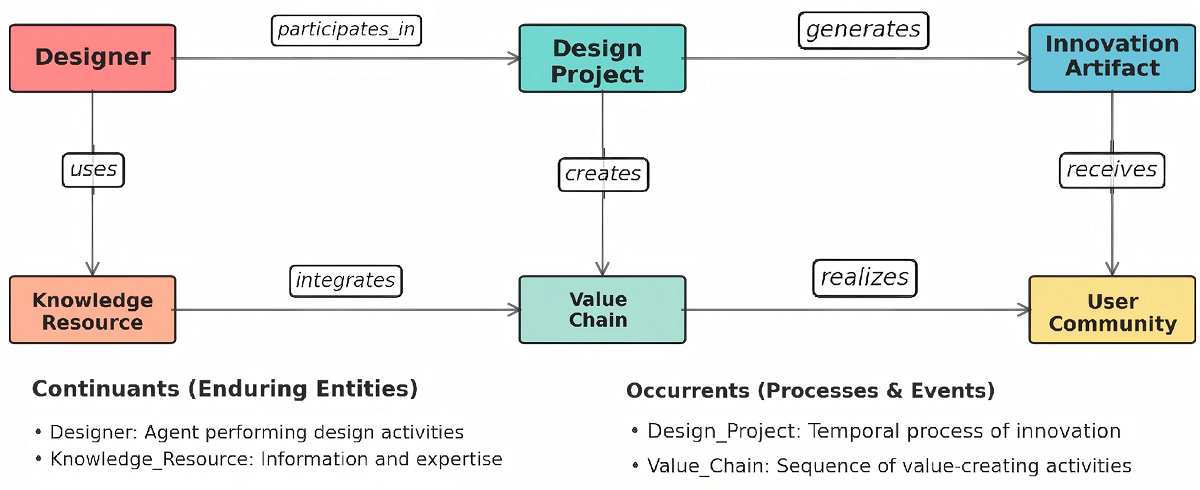
The increasing complexity of innovation demands a paradigm shift from isolated endeavors to interconnected ecosystems. However, the conceptual and relational underpinnings of Design Innovation Ecosystems (DIEs) remain largely informal and fragmented, hindering systematic analysis and knowledge integration. This paper introduces the Design Innovation Relation Ontology (DIRO), a formal framework grounded in Basic Formal Ontology (BFO) and Relation Ontology principles. DIRO provides machine-readable and logically coherent representations of DIEs through 18 core classes and 24 formal relations. The framework is implemented in Web Ontology Language (OWL 2 DL) and validated against 20 cross-disciplinary design innovation projects spanning diverse domains. Validation results demonstrate high performance: average competency coverage of 92.8% (23.2/25 questions answered), ontology coverage of 89.8%, and query response time of 0.68 seconds. The DIRO framework successfully captures complex dependencies and facilitates automated reasoning about innovation pathways and knowledge flows. This work bridges the gap between philosophical underpinnings of design and computational requirements of modern knowledge management, providing a foundational contribution to the nascent field of design innovation science.
Downloads
References
[1]Moore, J. F. (1993). Predators and prey: a new ecology of competition. Harvard business review, 71(3), 75-86.
[2]Erkko, A., & Llewellyn, D. W. (2014). Innovation ecosystems: Implications for innovation management. The Oxford handbook of innovation management, 204-228.
[3]Wächter, P. (2011). Thinking in systems–a primer.
[4]Sowa, J. F. Knowledge Representation: Logical, Philosophical, and Computational Foundations.
[5]El-Diraby, T. E., & Kashif, K. F. (2005). Distributed ontology architecture for knowledge management in highway construction. Journal of Construction Engineering and Management, 131(5), 591-603.
[6]Gero, J. S. (1990). Design prototypes: a knowledge representation schema for design. AI magazine, 11(4), 26-26.
[7]Smith, B., & Grenon, P. (2004). The Cornucopia of Formal‐Ontological Relations. Dialectica, 58(3), 279-296.
[8]Adner, R. (2017). Ecosystem as structure: An actionable construct for strategy. Journal of management, 43(1), 39-58.
[9]Dias Sant´ Ana, T., de Souza Bermejo, P. H., Moreira, M. F., & de Souza, W. V. B. (2020). The structure of an innovation ecosystem: foundations for future research. Management Decision, 58(12), 2725-2742.
[10]Valkokari, K. (2015). Business, innovation, and knowledge ecosystems: How they differ and how to survive and thrive within them. Technology innovation management review, 5(8).
[11]Beitz, W., Pahl, G., & Grote, K. (1996). Engineering design: a systematic approach. Mrs Bulletin, 71(30), 3.
[12]Rowe, P. G. (1991). Design thinking. MIT press.
[13]Razzouk, R., & Shute, V. (2012). What is design thinking and why is it important?. Review of educational research, 82(3), 330-348.
[14]Sanfilippo, E. M., Masolo, C., & Porello, D. (2015). Design knowledge representation: An ontological perspective.
[15]Pereira, A. R., Ferreira, J. J. P., & Lopes, A. (2020). A knowledge representation of the beginning of the innovation process: The Front End of Innovation Integrative Ontology (FEI2O). Data & Knowledge Engineering, 125, 101760.
[16]Gruber, T. R. (1995). Toward principles for the design of ontologies used for knowledge sharing?. International journal of human-computer studies, 43(5-6), 907-928.
[17]Smith, B., Ashburner, M., Rosse, C., Bard, J., Bug, W., Ceusters, W., ... & Lewis, S. (2007). The OBO Foundry: coordinated evolution of ontologies to support biomedical data integration. Nature biotechnology, 25(11), 1251-1255.
[18]Arp, R., Smith, B., & Spear, A. D. (2015). Building ontologies with basic formal ontology. Mit Press.
[19]Gruninger, M. (1995). Methodology for the design and evaluation of ontologies. In Proc. IJCAI'95, Workshop on Basic Ontological Issues in Knowledge Sharing.
[20]Service, R. W. (2009). Book review: Corbin, J., & Strauss, A.(2008). Basics of qualitative research: techniques and procedures for developing grounded theory . Thousand Oaks, CA: Sage. Organizational Research Methods, 12(3), 614-617.
Downloads
Published
How to Cite
Issue
Section
Categories
License
Copyright (c) 2026 Big.D

This work is licensed under a Creative Commons Attribution-NonCommercial-NoDerivatives 4.0 International License.