
Ethical Self-Location in Artificial Intelligence: A Recursive Framework for Value Alignment and Moral Agency
DOI:
https://doi.org/10.64504/big.d.v3i3.779Keywords:
artificial intelligence ethics, value alignment, multi-agent systems, recursive self-location, moral agencyAbstract
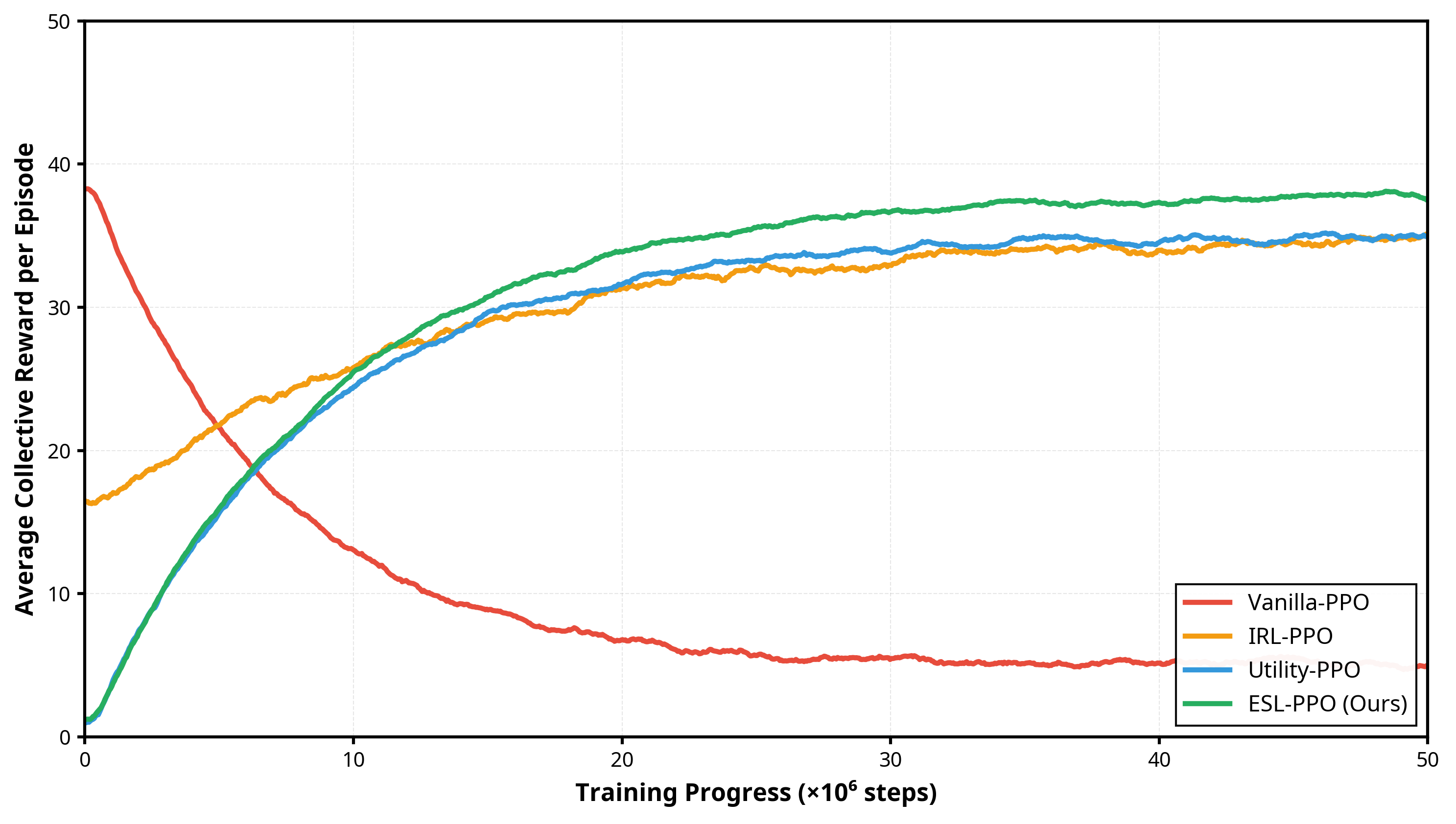
As artificial intelligence (AI) systems become increasingly autonomous and integrated into the fabric of society, ensuring their behavior aligns with human values has become a paramount challenge. Existing approaches to AI ethics often struggle to bridge the gap between abstract principles and concrete computational implementation, particularly in dynamic multi-agent environments. This paper introduces a novel theoretical and computational framework termed “Ethical Self-Location” (ESL), inspired by philosophical and cognitive science theories of recursive spatiotemporal self-location in consciousness. We propose that an AI's capacity for moral agency is contingent on its ability to recursively locate its own position within a shared, dynamic ethical-normative space relative to other agents and established values. This framework is instantiated and tested within a series of complex multi-agent reinforcement learning (MARL) simulations designed to model social dilemmas. Our results demonstrate that agents equipped with the ESL mechanism exhibit significantly higher levels of cooperative behavior, adaptability to shifting normative contexts, and alignment with predefined ethical objectives compared to state-of-the-art baseline models. The ESL framework provides a computationally tractable approach for imbuing AI with a rudimentary form of moral self-awareness, offering a new pathway toward developing more robust, transparent, and trustworthy autonomous systems.
Downloads
References
[1]Russell, S., & Norvig, P. (2021). Artificial Intelligence: a modern approach, 4th US ed. aima: сайт. URL: https://aima. cs. berkeley. edu/(дата обращения: 26.02. 2023).
[2]Hadfield-Menell, D., Russell, S. J., Abbeel, P., & Dragan, A. (2016). Cooperative inverse reinforcement learning. Advances in neural information processing systems, 29.
[3]Christiano, P. F., Leike, J., Brown, T., Martic, M., Legg, S., & Amodei, D. (2017). Deep reinforcement learning from human preferences. Advances in neural information processing systems, 30.
[4]Selbst, A. D., & Barocas, S. (2016). Big data’s disparate impact. California Law Review, 104(3).
[5]Lahusen, C., Maggetti, M., & Slavkovik, M. (2024). Trust, trustworthiness and AI governance. Scientific Reports, 14(1), 20752.
[6]Moor, J. H. (2006). The nature, importance, and difficulty of machine ethics. IEEE intelligent systems, 21(4), 18-21.
[7]Wallach, W., & Allen, C. (2008). Moral machines: Teaching robots right from wrong. Oxford University Press.
[8]Sharkey, A., & Sharkey, N. (2012). Granny and the robots: ethical issues in robot care for the elderly. Ethics and information technology, 14(1), 27-40.
[9]Ouyang, L., Wu, J., Jiang, X., Almeida, D., Wainwright, C., Mishkin, P., ... & Lowe, R. (2022). Training language models to follow instructions with human feedback. Advances in neural information processing systems, 35, 27730-27744.
[10]Peters, F. (2009). Consciousness as recursive, spatiotemporal self-location. Nature Precedings, 1-1.
[11]Soares, N., & Fallenstein, B. (2017). Agent foundations for aligning machine intelligence with human interests: a technical research agenda. In The technological singularity: Managing the journey (pp. 103-125). Berlin, Heidelberg: Springer Berlin Heidelberg.
[12]Amodei, D., Olah, C., Steinhardt, J., Christiano, P., Schulman, J., & Mané, D. (2016). Concrete problems in AI safety. arXiv preprint arXiv:1606.06565.
[13]Ng, A. Y., & Russell, S. (2000, June). Algorithms for inverse reinforcement learning. In Icml (Vol. 1, No. 2, p. 2).
[14]Ziegler, D. M., Stiennon, N., Wu, J., Brown, T. B., Radford, A., Amodei, D., ... & Irving, G. (2019). Fine-tuning language models from human preferences. arXiv preprint arXiv:1909.08593.
[15]Bai, Y., Kadavath, S., Kundu, S., Askell, A., Kernion, J., Jones, A., ... & Kaplan, J. (2022). Constitutional ai: Harmlessness from ai feedback. arXiv preprint arXiv:2212.08073.
[16]Leibo, J. Z., Zambaldi, V., Lanctot, M., Marecki, J., & Graepel, T. (2017). Multi-agent reinforcement learning in sequential social dilemmas. arXiv preprint arXiv:1702.03037.
[17]Palmer, G., Tuyls, K., Bloembergen, D., & Savani, R. (2017). Lenient multi-agent deep reinforcement learning. arXiv preprint arXiv:1707.04402.
[18]Foerster, J., Assael, I. A., De Freitas, N., & Whiteson, S. (2016). Learning to communicate with deep multi-agent reinforcement learning. Advances in neural information processing systems, 29.
[19]Lowe, R., Wu, Y. I., Tamar, A., Harb, J., Pieter Abbeel, O., & Mordatch, I. (2017). Multi-agent actor-critic for mixed cooperative-competitive environments. Advances in neural information processing systems, 30.
[20]Rabinowitz, N., Perbet, F., Song, F., Zhang, C., Eslami, S. A., & Botvinick, M. (2018, July). Machine theory of mind. In International conference on machine learning (pp. 4218-4227). PMLR.
[21]Nematzadeh, A., Burns, K., Grant, E., Gopnik, A., & Griffiths, T. (2018). Evaluating theory of mind in question answering. In Proceedings of the 2018 Conference on Empirical Methods in Natural Language Processing (pp. 2392-2400).
[22]Cao, K., Lazaridou, A., Lanctot, M., Leibo, J. Z., Tuyls, K., & Clark, S. (2018). Emergent communication through negotiation. arXiv preprint arXiv:1804.03980.
[23]Rabinowitz, N., Perbet, F., Song, F., Zhang, C., Eslami, S. A., & Botvinick, M. (2018, July). Machine theory of mind. In International conference on machine learning (pp. 4218-4227). PMLR.
[24]Mead, G. H. (1934). Mind, self, and society from the standpoint of a social behaviorist.
Downloads
Published
How to Cite
Issue
Section
Categories
License
Copyright (c) 2026 Big.D

This work is licensed under a Creative Commons Attribution-NonCommercial-NoDerivatives 4.0 International License.