
Pedagogical Philosophies Embedded in AI-Generated Educational Content: A Cross-Cultural and Cross-Disciplinary Analysis
DOI:
https://doi.org/10.64504/big.d.v3i3.780Keywords:
AI educational systems, pedagogical philosophy, cross-cultural analysis, educational equity, epistemology, AI bias in educationAbstract
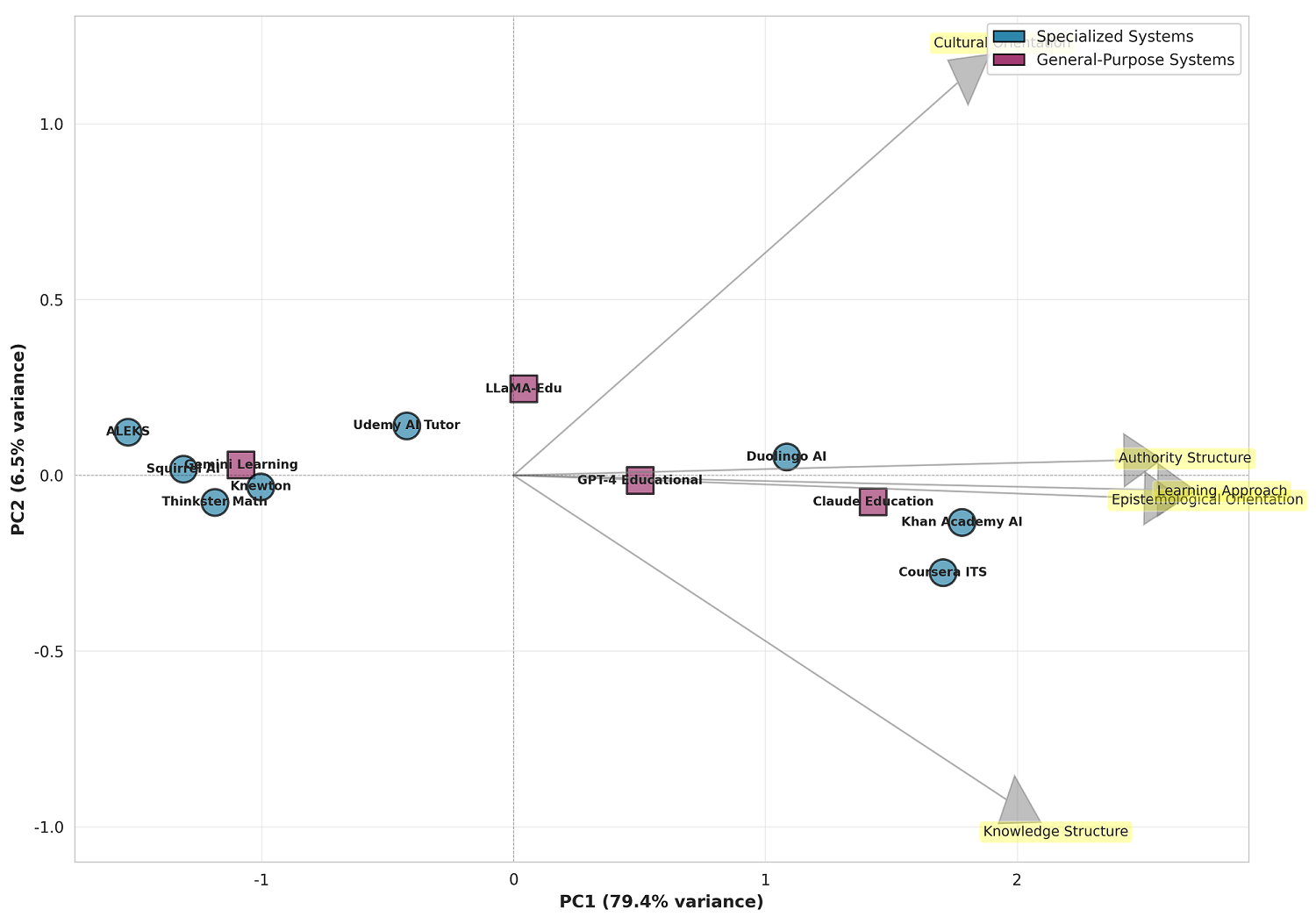
Artificial intelligence-powered educational content generation systems have become increasingly influential in shaping how students access and process educational information globally. However, the pedagogical philosophies embedded within these systems—reflecting the educational values, epistemological assumptions, and cultural perspectives of their designers—remain largely unexplored. This study investigates how twelve leading AI educational content generation systems (including platforms such as Khan Academy AI, Coursera’s AI tutoring system, and others) embed distinct pedagogical philosophies across multiple educational domains and cultural contexts. We employed a systematic evaluation methodology analyzing 2,847 AI-generated educational responses across five major domains (mathematics, science, history, language arts, and social studies) and six cultural-linguistic contexts (English, Mandarin Chinese, Spanish, Arabic, French, and Russian). Using a two-stage assessment strategy combined with principal component analysis and comparative visualization techniques, we identified significant variations in pedagogical approaches across systems, domains, and cultural contexts. Our findings reveal that AI educational systems systematically encode pedagogical philosophies reflecting constructivist versus transmissionist educational paradigms, individualist versus collectivist learning orientations, and culturally-specific epistemological assumptions about knowledge construction. These results demonstrate that pedagogical philosophies in AI educational systems are not culturally neutral but rather reflect the educational traditions and philosophical assumptions of their development contexts. This research has important implications for educational equity, curriculum design, and the need for culturally-responsive AI educational systems.
Downloads
References
[1]Ayeni, O. O., Al Hamad, N. M., Chisom, O. N., Osawaru, B., & Adewusi, O. E. (2024). AI in education: A review of personalized learning and educational technology. GSC Advanced Research and Reviews, 18(2), 261-271.
[2]Holmes, W., & Tuomi, I. (2022). State of the art and practice in AI in education. European journal of education, 57(4), 542-570.
[3]Miao, F., & Holmes, W. (2021). Artificial intelligence and education. Guidance for policy-makers.
[4]Zawacki-Richter, O., Marín, V. I., Bond, M., & Gouverneur, F. (2019). Systematic review of research on artificial intelligence applications in higher education–where are the educators?. International journal of educational technology in higher education, 16(1), 39.
[5]Selwyn, N. (2022). The future of AI and education: Some cautionary notes. European Journal of Education, 57(4), 620-631.
[6]Börekci, C., & Uyangör, N. (2021). Analyzing pre-service teachers’ educational philosophy preferences, curriculum design orientation, and epistemological beliefs with structural equation model. Participatory Educational Research, 8(3), 356-371.
[7]Brent, A. (2016). Philosophical foundations for the curriculum. Routledge.
[8]Xie, C., Wang, M., & Hu, H. (2018). Effects of constructivist and transmission instructional models on mathematics achievement in Mainland China: A meta-analysis. Frontiers in psychology, 9, 1923.
[9]Piaget, J. (2005). The psychology of intelligence. Routledge.
[10]Kiraly, D. C. (2015). Occasioning translator competence: Moving beyond social constructivism toward a postmodern alternative to instructionism. Translation and Interpreting Studies. The Journal of the American Translation and Interpreting Studies Association, 10(1), 8-32.
[11]Semenova, O. V. (2022). The European Proceedings of Social and Behavioural Sciences. In Knowledge, Man and Civilization-ISCKMC 2022 (pp. 936-943).
[12]Ouyang, S., Zhang, W., Xue, L., Rashid, A. M., Pyng, H. S., & Hassan, A. B. (2025). The cultural compass: A systematic review on cultural dimensions theory in educational settings. SAGE open, 15(2), 21582440251342160.
[13]O'neil, C. (2017). Weapons of math destruction: How big data increases inequality and threatens democracy. Crown.
[14]Noble, S. U. (2018). Algorithms of oppression: How search engines reinforce racism. In Algorithms of oppression. New York university press.
[15]Buyl, M., Rogiers, A., Noels, S., Bied, G., Dominguez-Catena, I., Heiter, E., ... & De Bie, T. (2026). Large language models reflect the ideology of their creators. npj Artificial Intelligence, 2(1), 7.
[16]Policy, M. (2005). The Brookings Institution. Egyptian Financial Markets for Micro, Small and Medium Enterprises: General Survey on Bottlenecks for MSME’s Access to Finance.” Tokyo. DESIGNING YOUTH EMPLOYMENT POLICIES IN EGYPT, 39.
[17]Chinta, S. V., Wang, Z., Yin, Z., Hoang, N., Gonzalez, M., Quy, T. L., & Zhang, W. (2024). FairAIED: Navigating fairness, bias, and ethics in educational AI applications. arXiv preprint arXiv:2407.18745.
[18]Kozikoğlu, İ., & Uygun, N. (2018). Investigation of the relationship between teachers' philosophies of education beliefs and curriculum design approaches. Çukurova Üniversitesi Eğitim Fakültesi Dergisi, 47(2), 411-438.
[19]Wang, L., Ma, C., Feng, X., Zhang, Z., Yang, H., Zhang, J., ... & Wen, J. (2024). A survey on large language model based autonomous agents. Frontiers of Computer Science, 18(6), 186345.
[20]Gallegos, I. O., Rossi, R. A., Barrow, J., Tanjim, M. M., Kim, S., Dernoncourt, F., ... & Ahmed, N. K. (2024). Bias and fairness in large language models: A survey. Computational linguistics, 50(3), 1097-1179.
[21]Barnes, A. J., Zhang, Y., & Valenzuela, A. (2024). AI and culture: Culturally dependent responses to AI systems. Current opinion in psychology, 58, 101838.
[22]Ge, X., Xu, C., Misaki, D., Markus, H. R., & Tsai, J. L. (2024, May). How culture shapes what people want from AI. In Proceedings of the 2024 CHI conference on human factors in computing systems (pp. 1-15).
[23]Cobern, W. W. (1993). Constructivism. Journal of Educational and Psychological Consultation, 4(1), 105-112.
[24]Mann, K., & MacLeod, A. (2015). Constructivism: learning theories and approaches to research. Researching medical education, 49-66.
[25]Vygotsky, L. S. (2012). Thought and language (Vol. 29). MIT press.
[26]Holmes, W., & Porayska-Pomsta, K. (2023). The ethics of artificial intelligence in education. Lontoo: Routledge, 621-653.
[27]Talan, T. (2021). Artificial intelligence in education: A bibliometric study.
[28]Nazaretsky, T., Cukurova, M., Ariely, M., & Alexandron, G. (2021, September). Confirmation bias and trust: human factors that influence teachers' attitudes towards AI-based educational technology. In CEUR workshop proceedings (Vol. 3042).
[29]Hruby, G. G., & Roegiers, A. B. (2012). Cognitive constructivism. The encyclopedia of applied linguistics, 1-5.
[30]Araujo, L. (2007). Markets, market-making and marketing. Marketing theory, 7(3), 211-226.
Downloads
Published
How to Cite
Issue
Section
Categories
License
Copyright (c) 2026 Big.D

This work is licensed under a Creative Commons Attribution-NonCommercial-NoDerivatives 4.0 International License.