
Bridging Values and Logic: Philosophical Thought Analysis for Coherence Alignment in Artificial Intelligence Decision Systems: A Cross-disciplinary Approach to Resolving Value Conflicts in AI Ethics
DOI:
https://doi.org/10.64504/big.d.v3i3.783Keywords:
Artificial Intelligence ethics, philosophical thought analysis, value alignment, cognitive dissonance, logical reasoning in AIAbstract
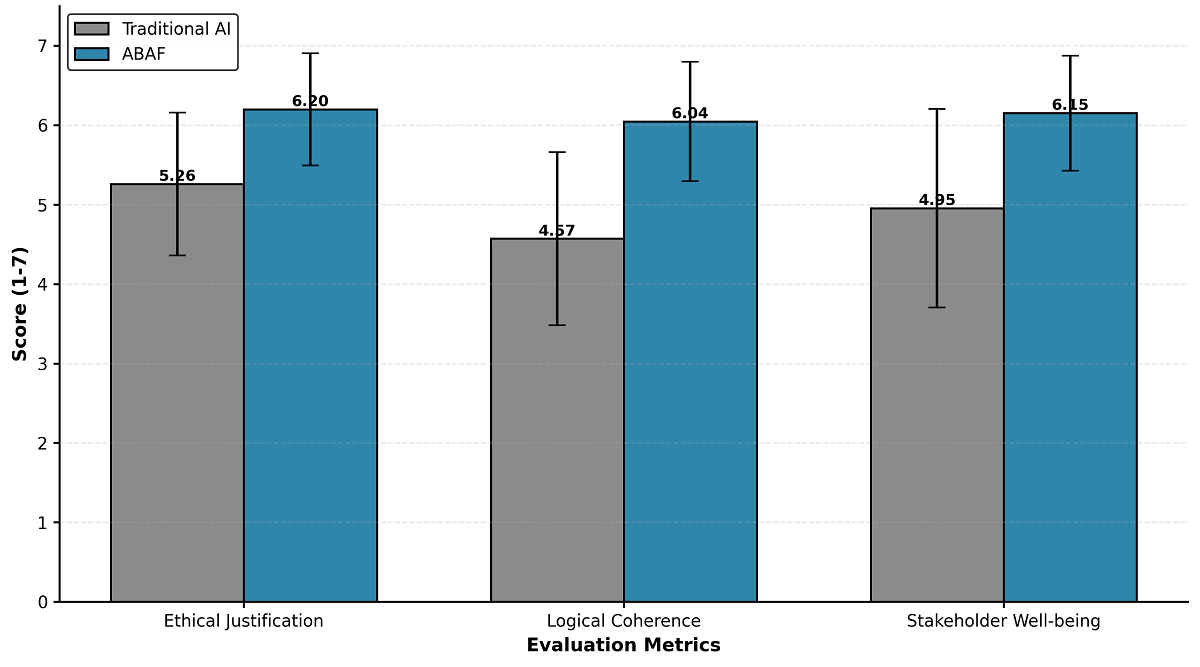
Artificial Intelligence (AI) decision systems are increasingly integral to critical domains, yet they frequently encounter complex value conflicts that challenge their ethical integrity. Existing AI ethics frameworks, while valuable, often neglect the internal logical coherence of an AI's 'belief' system, leading to inconsistent and unpredictable decision-making. This paper introduces a novel approach, grounded in philosophical thought analysis, to address this gap. We adapt principles from cognitive dissonance theory and logical reasoning to develop the AI Belief Alignment Framework (ABAF), a systematic methodology for identifying, analyzing, and resolving value conflicts within AI. The framework is implemented and tested across three simulated high-stakes scenarios: autonomous driving, medical diagnostics, and content recommendation. Our findings demonstrate that applying philosophical thought analysis significantly enhances the coherence and ethical consistency of AI decisions compared to traditional models. This research contributes a new, philosophically informed perspective to the value alignment problem, offering a practical pathway toward developing more robust, transparent, and ethically sound AI systems.
Downloads
References
[1]Jobin, A., Ienca, M., & Andorno, R. (2019). The global landscape of AI ethics guidelines. Nature Machine Intelligence, 1(9), 389-399.
[2]Gabriel, I. (2020). Artificial intelligence, values, and alignment. Minds and Machines, 30(3), 411-437.
[3]Bonnefon, J. F., Shariff, A., & Rahwan, I. (2016). The social dilemma of autonomous vehicles. Science, 352(6293), 1573-1576.
[4]Selbst, A. D., & Barocas, S. (2019). The intuitive appeal of explainable machines. Fordham L. Rev., 87, 1085.
[5]Vallor, S. (2016). Technology and the virtues: A philosophical guide to a future worth wanting. Oxford University Press.
[6]Ribeiro, M. T., Singh, S., & Guestrin, C. (2016, August). " Why should i trust you?" Explaining the predictions of any classifier. In Proceedings of the 22nd ACM SIGKDD international conference on knowledge discovery and data mining (pp. 1135-1144).
https://doi.org/10.1145/2939672.2939778
[7]Valentinovich, B. S. (2018). Theory and practice of philosophical counseling: a comparative approach. Turk Online J Des Art Commun, 8, 149-154. https://doi.org/10.7456/1080MSE/119
[8]Russell, S. (2022). Human-Compatible Artificial Intelligence. Human-like machine intelligence, 1, 3-22.
[9]Christiano, P. F., Leike, J., Brown, T., Martic, M., Legg, S., & Amodei, D. (2017). Deep reinforcement learning from human preferences. Advances in neural information processing systems, 30.
[10]Sap, M., Gabriel, S., Qin, L., Jurafsky, D., Smith, N. A., & Choi, Y. (2020, July). Social bias frames: Reasoning about social and power implications of language. In Proceedings of the 58th annual meeting of the association for computational linguistics (pp. 5477-5490). https://doi.org/10.18653/v1/2020.acl-main.486
[11]Anderson, M., & Anderson, S. L. (2020). Machine ethics: Creating an ethical intelligent agent. In The Ethics of Information Technologies (pp. 99-110). Routledge.
[12]Schuster, N., & Kilov, D. (2025). Moral disagreement and the limits of AI value alignment: a dual challenge of epistemic justification and political legitimacy. AI & society, 1-15.
https://doi.org/10.1007/s00146-025-02427-2
[13]Moor, J. H. (2006). The nature, importance, and difficulty of machine ethics. IEEE intelligent systems, 21(4), 18-21.
https://doi.org/10.1109/MIS.2006.80
[14]Wang, P., & Goertzel, B. (Eds.). (2012). Theoretical foundations of artificial general intelligence (Vol. 4). Springer Science & Business Media.
[15]Yu, S., Wang, Y., Yang, M., Li, B., Qu, Q., & Shen, J. (2019, January). NAIRS: A neural attentive interpretable recommendation system. In Proceedings of the twelfth ACM international conference on web search and data mining (pp. 790-793).
https://doi.org/10.1145/3289600.3290609
[16]Friedman, B., Hendry, D. G., & Borning, A. (2017). A survey of value sensitive design methods. Foundations and Trends® in Human–Computer Interaction, 11(2), 63-125.
https://doi.org/10.1561/1100000015
[17]Lundberg, S. M., & Lee, S. I. (2017). A unified approach to interpreting model predictions. Advances in neural information processing systems, 30.
[18]Festinger, L. (1957). A theory of cognitive dissonance. Stanford University Press.
[19]IEEE Global Initiative on Ethics of Autonomous and Intelligent Systems. (2017). Ethically aligned design: First edition. IEEE.
[20]Rawls, J. (2017). A theory of justice. In Applied ethics (pp. 21-29). Routledge.
[21]Amodei, D., Olah, C., Steinhardt, J., Christiano, P., Schulman, J., & Mané, D. (2016). Concrete problems in AI safety. arXiv preprint arXiv:1606.06565. https://doi.org/10.48550/arXiv.1606.06565
[22]Aristotle, & Ross, W. D. (2017). Nicomachean Ethics. Cambridge University Press.
[23]Mozgunova, L. (2024). A Critical Overview of the Fundamental Aspects of the Proposal for a Regulation of the European Parliament and of the Council Laying Down Harmonised Rules on Artificial Intelligence. Available at SSRN 4724557.
Downloads
Published
How to Cite
Issue
Section
Categories
License
Copyright (c) 2026 Big.D

This work is licensed under a Creative Commons Attribution-NonCommercial-NoDerivatives 4.0 International License.