
Leveraging Artificial Intelligence for Ethical Design Decision-Making: Philosophical Perspectives on Technical Integration, Value Proposition, and Implementation Challenges
DOI:
https://doi.org/10.64504/big.d.v3i3.790Keywords:
Design Ethics, Artificial Intelligence, Ethical Decision-Making, Explainable AI (XAI), Retrieval-Augmented Generation, EngineeringAbstract
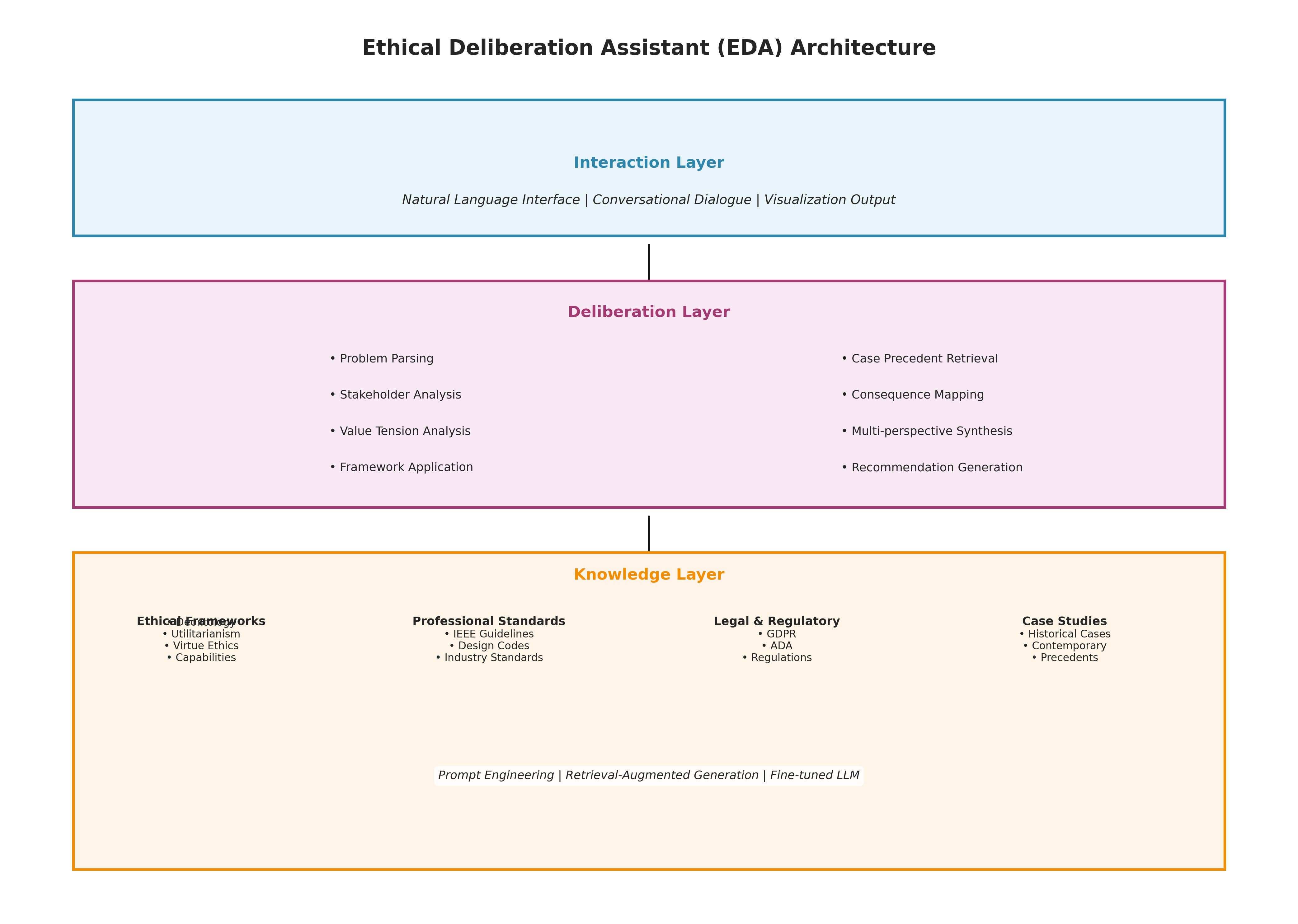
Ethical considerations are paramount in modern engineering design, yet designers often lack systematic tools for navigating complex ethical dilemmas. This paper proposes an AI-driven system, the Ethical Deliberation Assistant (EDA), to enhance ethical decision-making in design. The EDA integrates advanced technical strategies, including prompt engineering, Retrieval-Augmented Generation (RAG), and fine-tuning of Large Language Models (LLMs), with established ethical frameworks. Our technical framework details the system architecture and implementation, focusing on quantifiable metrics for ethical assessment. Experimental evaluation demonstrates that the EDA significantly improves the consistency and accuracy of ethical evaluations, achieving an 86% accuracy rate compared to expert judgments and reducing analysis time by 90%. This system provides structured ethical guidance, broadens access to ethical expertise, and fosters a more reflective and efficient design practice, addressing critical engineering challenges in responsible AI development.
Downloads
References
[1]Jiao, J., Afroogh, S., Murali, A., Chen, K., Atkinson, D., & Dhurandhar, A. (2025). LLM ethics benchmark: a three-dimensional assessment system for evaluating moral reasoning in large language models. Scientific Reports, 15(1), 34642.
[2]Kapania, S., Wang, R., Li, T. J. J., Li, T., & Shen, H. (2025). 'I'm Categorizing LLM as a Productivity Tool': Examining Ethics of LLM Use in HCI Research Practices. Proceedings of the ACM on Human-Computer Interaction, 9(2), 1-26.
[3]Singh, S. (2025). Systems Engineering of Large Language Models for Enterprise Applications.
[4]Zhou, Y., & Chen, C. H. (2025). Examining the impact of large language models on design: Functions, strengths, limitations, and roles. Design and Artificial Intelligence, 100017.
[5]Esmaeilzadeh, P. (2025). Ethical implications of using general-purpose LLMs in clinical settings: a comparative analysis of prompt engineering strategies and their impact on patient safety. BMC Medical Informatics and Decision Making, 25(1), 342.
[6]Hadar-Shoval, D., Asraf, K., Shinan-Altman, S., Elyoseph, Z., & Levkovich, I. (2024). Embedded values-like shape ethical reasoning of large language models on primary care ethical dilemmas. Heliyon, 10(18).
[7]Ferdaus, M. M., Abdelguerfi, M., Loup, E., N. Niles, K., Pathak, K., & Sloan, S. (2026). Towards trustworthy AI: a review of ethical and robust large language models. ACM Computing Surveys, 58(7), 1-43.
[8]Awad, E., Levine, S., Anderson, M., Anderson, S. L., Conitzer, V., Crockett, M. J., ... & Tenenbaum, J. B. (2022). Computational ethics. Trends in cognitive sciences, 26(5), 388-405.
[9]Alkayyal, M., Malberg, S., & Groh, G. (2025, September). An LLM-Based Decision Support System for Strategic Decision-Making. In Joint European Conference on Machine Learning and Knowledge Discovery in Databases (pp. 460-464). Cham: Springer Nature Switzerland.
[10]Arif, S., Amjad, M. U., & Faisal, M. (2025). AI-Driven Decision Support Systems for Software Architecture: A Framework for Intelligent Design Decision-Making (2025). Journal of Computing and Artificial Intelligence, 3(1).
[11]Lewis, P., Perez, E., Piktus, A., Petroni, F., Karpukhin, V., Goyal, N., ... & Kiela, D. (2020). Retrieval-augmented generation for knowledge-intensive nlp tasks. Advances in neural information processing systems, 33, 9459-9474.
[12]Pradhan, R. (2025). RAG vs. Fine-Tuning vs. Prompt Engineering: A Comparative Analysis for Optimizing AI Models. International Journal of Computer Technology and Electronics Communication, 8(5), 11326-11333.
[13]Wang, Z., Liu, Z., Lu, W., & Jia, L. (2025). Improving knowledge management in building engineering with hybrid retrieval-augmented generation framework. Journal of Building Engineering, 103, 112189.
[14]Wan, Y., Chen, Z., Liu, Y., Chen, C., & Packianather, M. (2025). Empowering LLMs by hybrid retrieval-augmented generation for domain-centric Q&A in smart manufacturing. Advanced Engineering Informatics, 65, 103212.
[15]Gan, A., Yu, H., Zhang, K., Liu, Q., Yan, W., Huang, Z., ... & Hu, G. (2025). Retrieval augmented generation evaluation in the era of large language models: A comprehensive survey. arXiv preprint arXiv:2504.14891.
[16]Collaco, B. G., Srinivasagam, P., Gomez-Cabello, C. A., Haider, S. A., Genovese, A., Wood, N. G., ... & Forte, A. J. (2026). Integrating Fine-Tuning and Retrieval-Augmented Generation for Healthcare AI Systems: A Scoping Review. Bioengineering, 13(2), 225.
Downloads
Published
How to Cite
Issue
Section
Categories
License
Copyright (c) 2026 Big.D

This work is licensed under a Creative Commons Attribution-NonCommercial-NoDerivatives 4.0 International License.