
Bridging Dao and Digital Fabrication: A Collaborative Design Framework Integrating Eastern Craft Philosophy and Smart Manufacturing
DOI:
https://doi.org/10.64504/big.d.v3i3.827Keywords:
Dao-Vessel Symbiosis; Haptic Semiotics; Cultural Logic; Smart Manufacturing; Intangible Cultural Heritage Craft; CMF DesignAbstract
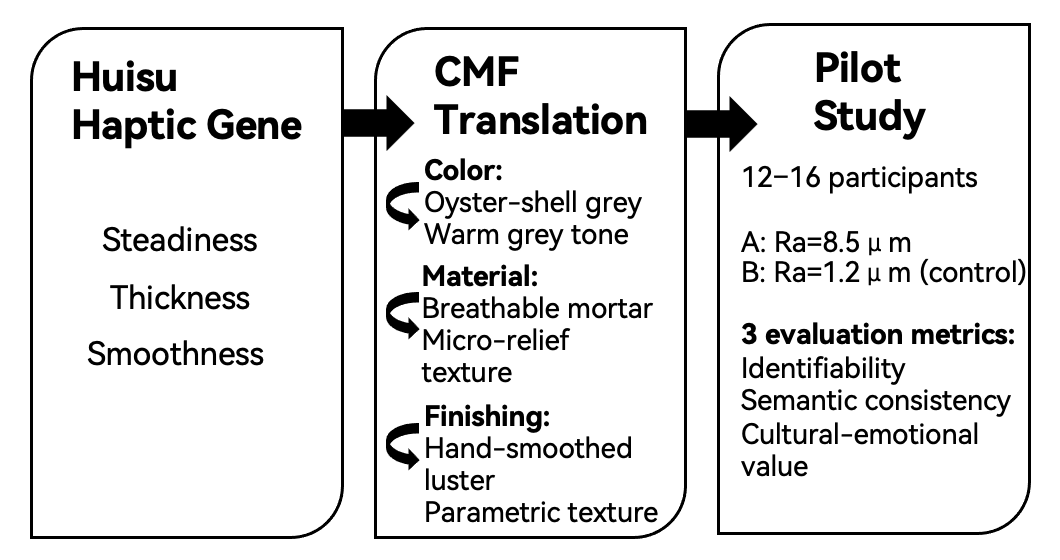
The global design field faces a binary dilemma between cultural logic and technological logic. Modern smart manufacturing is centered on efficiency and standardization, while traditional crafts are rooted in physical practice and cultural metaphor. These two logics have long been positioned as “protection” versus “replacement” in design practice, rather than in symbiosis. This study proposes the Dao-Vessel Symbiosis framework, which translates core concepts of Eastern craft philosophy (e.g., harmony between humanity and nature, artifacts carrying cultural ideas) into the Triadic Haptic-Semiotic Model—an operable framework for industrial design and smart manufacturing systems. The model consists of three progressive layers: the physical layer (quantitative acquisition of material tactile parameters), the behavioral layer (motion coding of craftsmen’s body movements), and the semantic layer (cultural decoding of tactile metaphors), establishing a translatable pathway between cultural logic and technological logic. This research validates the framework using two typical intangible cultural heritage (ICH) crafts in Lingnan, China: Huisu (lime sculpture) and Guangcai (Canton enamelware). For Huisu, motion capture and semantic decoding of “pushing, pressing, and smoothing” gestures extract the tactile cultural genes of steadiness, thickness, and smoothness. For Guangcai, physical tactile measurement of “gold-threading and piling jade” techniques translates the cultural semantics of golden splendor, thinness, and complexity. The extracted cultural tactile factors are applied and tested in two real smart manufacturing scenarios: automotive interior CMF (Color, Material, Finish) design and digital cultural tourism interactive equipment. Results confirm that cultural logic is not a decorative supplement to smart manufacturing, but a structural element that enhances product emotional value, reduces homogeneous competition, and extends product lifecycle. The framework provides a transferable methodological pathway for global traditional crafts to empower regional smart manufacturing upgrades.
Downloads
References
[1]Askool Y. S. Bark. Advancing Digital Transformation and Innovative Talent Cultivation of African Traditional Crafts. Big.D, 2026, 3(2): 68-77.
[2]Habibi R, Atta E, Jawad S. U. R. Deep Learning Vision Models Reveal Neural Dynamics of Digital Interface Interaction: A Design Neuroscience Approach. Big.D, 2026, 3(1): 1-12.
[3]A. Krishna, “An integrative review of sensory marketing: Engaging the senses to affect perception, judgment and behavior,” Journal of Consumer Psychology, vol. 22, no. 3, pp. 332–351, 2012. DOI: 10.1016/j.jcps.2012.09.002.
[4]He Renke, “Human Factors and Cultural Data-Driven Intelligent Design” (Academic Lecture), Annual Conference of the Human Factors Engineering and Industrial Innovation Committee, China Creative Studies Institute, University of South China, November 2025; also reported in multiple university lecture reports at Tianjin University, Hunan University of Technology, etc., 2025.
[5]“Smart Cockpit Emotional Design: A Multimodal Data-Driven Use-Speech-Psychology Joint Analysis Method,” Industrial Engineering, 2024.
[6]The Artificers' Record (Kao Gong Ji), Spring and Autumn and Warring States Period.
[7]“Craft Characteristics of Lingnan Huisu,” Lingnan Huisu Digital Museum (lingnanhuisu.gdut.edu.cn).
[8]The Book of Changes (Xici), Western Zhou to Warring States Period.
[9]Tang Hansen, Zhang Maolin, and Liu Qihuan, “A Review of the Origin and Staging of 'Guangcai',” China Ceramic Industry, vol. 30, no. 3, pp. 47–51, 2023.
[10]Zhuangzi: The Secret of Caring for Life, Warring States Period.
[11]C. Nimkulrat and C. Groth, “Design- and craft thinking analysed as embodied cognition,” FormAkademisk, vol. 9, no. 1, 2016. DOI: 10.7577/formakademisk.1481.
[12]He Renke, “A Human-Centered Intelligent Design Big Data System” (Academic Report), Design Intelligence Award (DIA), Hangzhou, Zhejiang, 2023.
[13]A. M. L. Kappers and W. M. Bergmann Tiest, “Haptic perception,” Wiley Interdisciplinary Reviews: Cognitive Science, vol. 4, no. 4, pp. 357–374, 2013. DOI: 10.1002/wcs.1238.
[14]N. Partarakis, X. Zabulis, A. Chatziantoniou, N. Patsiouras, and I. Adami, “An approach to the creation and presentation of reference gesture datasets, for the preservation of traditional crafts,” Applied Sciences, vol. 10, no. 20, 7325, 2020. DOI: 10.3390/app10207325.
[15]X. Zabulis, N. Partarakis, V. Bartalesi, N. Pratelli, C. Meghini, A. Dubois, I. Moreno, and S. Manitsaris, “Multimodal Dictionaries for Traditional Craft Education,” Multimodal Technologies and Interaction, vol. 8, 63, 2024. DOI: 10.3390/mti8080063.
[16]Yu Juan and Zhao Bin, “Putting 'Digital Armor' on Elderly Craftsmen,” People's Daily, December 29, 2025.
[17]Zhang Lu et al., “Digital Acquisition of Yunnan Intangible Cultural Heritage Traditional Dances,” Yunnan Network, December 15, 2025.
[18]Yao Dan, “The Cultural Concealment of 'Things': A Study of the Interaction between 'Hubi' Writing Brushes and the Literati Circle of Jiangsu and Zhejiang in the Yuan Dynasty,” National Social Science Fund Art Project (2020BH00977).
[19]J.D. Power, “2024 China New Energy Vehicle Customer Experience Value Study (NEV-CXVI),” September 2024.
[20]“2024 China Automobile After-Sales Service Customer Satisfaction (CAACS Survey),” China Association of Automobile Maintenance and Repair, November 2024.
[21]CMF Design Award Committee, “CMF Gold Award: Prospective Vehicle Design – GAC Research Institute,” 2024.
[22]S. Prabhuraj, “Analysis of Physiological Effects of Multisensory Stimuli in Automotive Cabin Spaces,” M.S. thesis, Dept. Ind. Des. Eng., TU Delft, 2025.
[23]H. Oral Karakoç, “Digitization of craft knowledge in architecture: Translations and transfers,” Journal of Computational Design, vol. 5, no. 2, pp. 163–182, 2024.
[24]Tang Bangbei, Guo Gang, and Xia Jinjun, “Research on Industrial Design Material Evaluation Method Based on User Visual/Haptic Experience,” Journal of Mechanical Engineering, vol. 53, no. 3, pp. 162–170, 2017.
[25]Yin Yanqing, Zhao Danhua, and Tan Zhengyu, “Research on the Perception Modality of Automotive Interior Quality,” Packaging Engineering, vol. 37, no. 20, pp. 35–40, 2016.
[26]J. J. Marquez, A. Etxeberria, and M. J. Varas, “Tactile and visual perception of plastic textures for car interiors: Psychophysical and affective dimensions,” International Journal of Industrial Ergonomics, vol. 91, 103348, 2022. DOI: 10.1016/j.ergon.2022.103348.
[27]V. Hayward, O. R. Astley, M. Cruz-Hernandez, D. Grant, and G. Robles-De-La-Torre, “Haptic interfaces and devices,” Sensor Review, vol. 24, no. 1, pp. 16–29, 2004. DOI: 10.1108/02602280410515770.
[28]Y. Gaffary and A. Lécuyer, “A theoretical framework of haptic processing in automotive user interfaces and its implications on design and engineering,” Frontiers in Psychology, vol. 10, 1470, 2019. DOI: 10.3389/fpsyg.2019.01470.
[29]M. Herzfeld, Anthropology: Theoretical Practice in Culture and Society, Malden, MA: Blackwell Publishers, 2001.
[30]P. Sandheinrich and J. Hutson, “Haptic Preservation of Cultural Ephemera: An Extended Reality Solution Using Stereoscopic Experience Replication for Victorian Parlor Culture,” Metaverse Basic and Applied Research, vol. 2, p. 48, 2023. DOI: 10.56294/mr202348.
[31]A. W. van Laack, Measurement of Sensory and Cultural Influences on Haptic Quality Perception of Vehicle Interiors. Van Laack GmbH, 2014. ISBN: 9783936624250.
Downloads
Published
How to Cite
Issue
Section
Categories
License
Copyright (c) 2026 Big.D

This work is licensed under a Creative Commons Attribution-NonCommercial-NoDerivatives 4.0 International License.