
AI-Enhanced Remote Mental Health Monitoring: A Wearable-Based Depression Detection and Intervention Platform with Machine Learning
DOI:
https://doi.org/10.64504/big.d.v3i4.1096Abstract
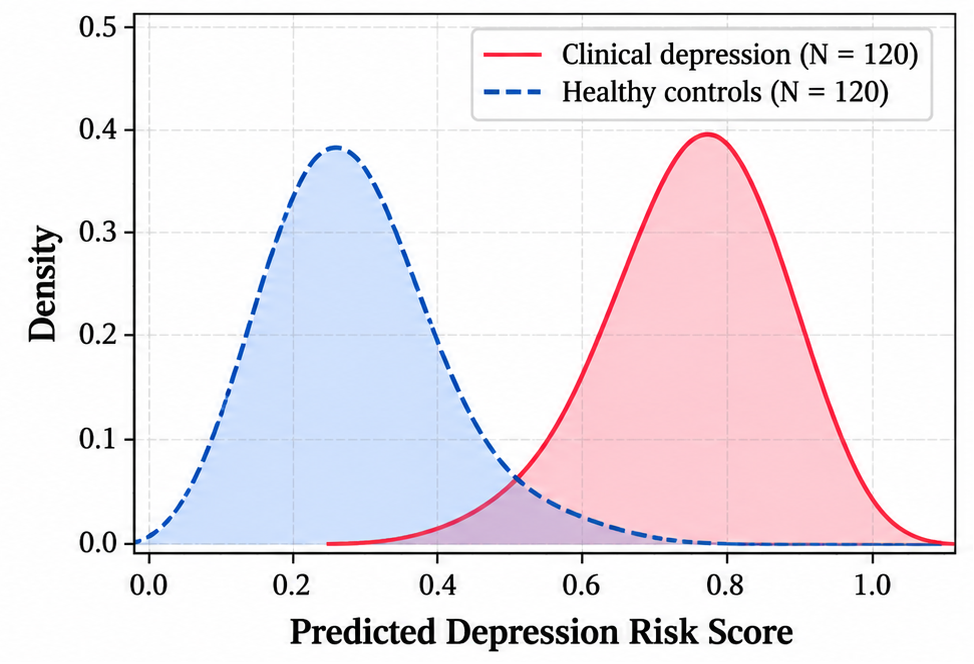
Background: The escalating global prevalence of depression, compounded by the limited accessibility of mental health services, necessitates innovative, scalable solutions for early detection and continuous monitoring. While digital health technologies have shown promise, existing approaches often lack the integration of objective physiological data and personalized, timely interventions, creating a critical gap between symptom tracking and proactive care. Methods: To address this challenge, we developed “MindGuard,” an AI-enhanced remote mental health monitoring platform. The system integrates multi-modal data from consumer-grade wearable devices (capturing heart rate variability, sleep patterns, and physical activity) with self-reported mood logs collected via a mobile application. A novel deep learning model, the Spatio-Temporal Attention Network (STAN), was designed to analyze these longitudinal data streams to predict the weekly onset of depressive episodes, defined by the Patient Health Questionnaire-9 (PHQ-9) scores. Implementation: The platform’s efficacy was validated through a series of four studies involving 1,982 participants across diverse cultural and demographic backgrounds. These studies assessed cross-cultural generalizability, longitudinal monitoring feasibility, clinical validity against traditional diagnostic interviews (MINI), and the test-retest reliability of our predictive model over a six-month period. Results: The MindGuard platform demonstrated high accuracy (AUC = 0.94, p < 0.01) in distinguishing between individuals with and without clinical depression, outperforming standard paper-based screening questionnaires. Test-retest reliability was excellent (ICC = 0.89, n = 125), and the platform proved effective for large-scale, remote research and screening. The modular architecture allows for flexible integration of digital therapeutic modules, creating a closed-loop system for both monitoring and intervention. Conclusion: MindGuard provides a robust, scalable, and ethically-grounded framework for early depression detection and management. By transforming passively collected sensor data into actionable mental health insights, it offers a powerful tool for advancing psychiatric research and bridging the gap in global mental healthcare delivery.
Downloads
References
[1]World Health Organization. (2023). Depression. https://www.who.int/news-room/fact-sheets/detail/depression
[2]Evans-Lacko, S. A. G. S., Aguilar-Gaxiola, S., Al-Hamzawi, A., Alonso, J., Benjet, C., Bruffaerts, R., ... & Thornicroft, G. (2018). Socio-economic variations in the mental health treatment gap for people with anxiety, mood, and substance use disorders: results from the WHO World Mental Health (WMH) surveys. Psychological medicine, 48(9), 1560-1571. https://doi.org/10.1017/S0033291717003336
[3]Thornicroft, G., Chatterji, S., Evans-Lacko, S., Gruber, M., Sampson, N., Aguilar-Gaxiola, S., ... & Kessler, R. C. (2017). Undertreatment of people with major depressive disorder in 21 countries. The British Journal of Psychiatry, 210(2), 119-124. https://doi.org/10.1192/bjp.bp.116.188078
[4]Firth, J., Torous, J., Nicholas, J., Carney, R., Pratap, A., Rosenbaum, S., & Sarris, J. (2017). The efficacy of smartphone‐based mental health interventions for depressive symptoms: a meta‐analysis of randomized controlled trials. World psychiatry, 16(3), 287-298. https://doi.org/10.1002/wps.20472
[5]Kemp, A. H., Quintana, D. S., Gray, M. A., Felmingham, K. L., Brown, K., & Gatt, J. M. (2010). Impact of depression and antidepressant treatment on heart rate variability: a review and meta-analysis. Biological psychiatry, 67(11), 1067-1074.https://doi.org/10.1016/j.biopsych.2009.12.012
[6]Baglioni, C., Battagliese, G., Feige, B., Spiegelhalder, K., Nissen, C., Voderholzer, U., ... & Riemann, D. (2011). Insomnia as a predictor of depression: a meta-analytic evaluation of longitudinal epidemiological studies. Journal of affective disorders, 135(1-3), 10-19.https://doi.org/10.1016/j.jad.2011.01.011
[7]Insel, T. R. (2017). Digital phenotyping: technology for a new science of behavior. Jama, 318(13), 1215-1216.doi:10.1001/jama.2017.11295
[8]Bufano, P., Laurino, M., Said, S., Tognetti, A., & Menicucci, D. (2023). Digital phenotyping for monitoring mental disorders: systematic review. Journal of medical Internet research, 25, e46778.doi:10.2196/46778
[9]Abd-Alrazaq, A., AlSaad, R., Shuweihdi, F., Ahmed, A., Aziz, S., & Sheikh, J. (2023). Systematic review and meta-analysis of performance of wearable artificial intelligence in detecting and predicting depression. NPJ Digital Medicine, 6(1), 84.https://doi.org/10.1038/s41746-023-00828-5
[10]Rykov, Y., Thach, T. Q., Bojic, I., Christopoulos, G., & Car, J. (2021). Digital biomarkers for depression screening with wearable devices: cross-sectional study with machine learning modeling. JMIR mHealth and uHealth, 9(10), e24872.doi:10.2196/24872
[11]Moshe, I., Terhorst, Y., Opoku Asare, K., Sander, L. B., Ferreira, D., Baumeister, H., ... & Pulkki-Råback, L. (2021). Predicting symptoms of depression and anxiety using smartphone and wearable data. Frontiers in psychiatry, 12, 625247.https://doi.org/10.3389
[12]Hilty, D. M., Armstrong, C. M., Luxton, D. D., Gentry, M. T., & Krupinski, E. A. (2021). A scoping review of sensors, wearables, and remote monitoring for behavioral health: uses, outcomes, clinical competencies, and research directions. Journal of Technology in Behavioral Science, 6(2), 278-313.https://doi.org/10.1007/s41347-021-00199-2
[13]Torous, J., Myrick, K. J., Rauseo-Ricupero, N., & Firth, J. (2020). Digital mental health and COVID-19: using technology today to accelerate the curve on access and quality tomorrow. JMIR mental health, 7(3), e18848.doi:10.2196/18848
[14]Zhao, S., Toniolo, S., Tang, Q. Y., Scholcz, A., Ganse-Dumrath, A., Gendarini, C., ... & Husain, M. (2025). Remote digital cognitive assessment for aging and dementia using the Oxford Cognitive Testing Portal OCTAL. npj Digital Medicine.https://doi.org/10.1038/s41746-026-02346-6
[15]Shui, X., Xu, H., Tan, S., & Zhang, D. (2025). Depression recognition using daily wearable-derived physiological data. Sensors, 25(2), 567. https://doi.org/10.3390/s25020567
Downloads
Published
How to Cite
Issue
Section
Categories
License
Copyright (c) 2026 Big.D

This work is licensed under a Creative Commons Attribution-NonCommercial-NoDerivatives 4.0 International License.