
Harmonizing Energy Flow: A Parametric Approach to Sustainable Building Design Based on Daoist Philosophical Principles Computational Modeling of Yin-Yang Balance in Building Energy Systems
DOI:
https://doi.org/10.64504/big.d.v3i3.784Keywords:
Daoist philosophy, Parametric design, Building energy optimization, Sustainable architecture, Computational modelingAbstract
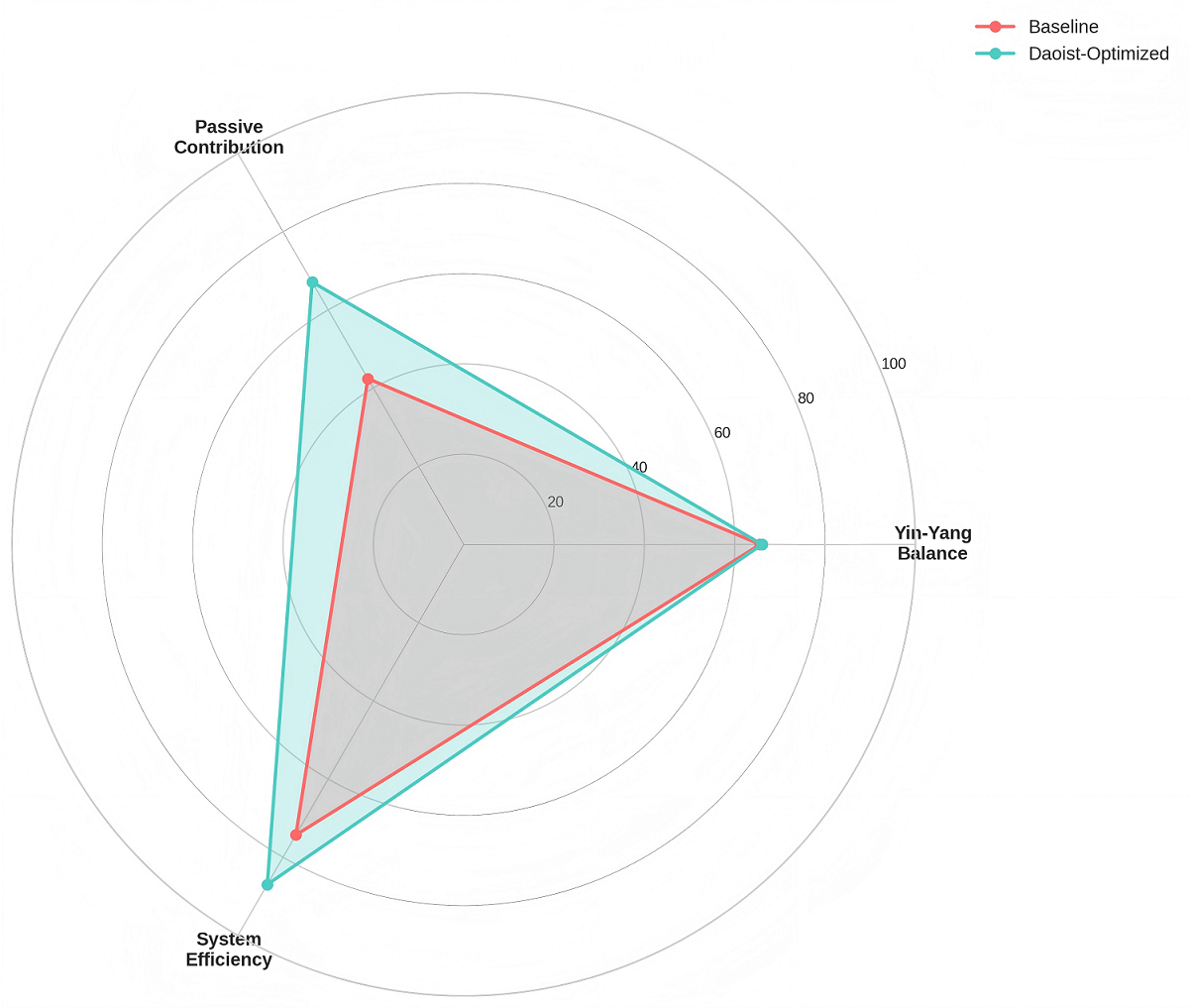
Sustainable building design is increasingly recognized as a critical component of global energy conservation efforts, yet prevailing optimization methodologies often prioritize purely technical metrics, overlooking the potential of holistic, philosophically grounded approaches. This research addresses this gap by proposing a novel parametric framework that integrates principles from classical Daoist philosophy into the computational optimization of building energy systems. We identify and formalize three core Daoist concepts—Yin-Yang balance, Wu Wei (effortless action), and Qi (energy) flow—into a parametric algorithm developed within a Rhino/Grasshopper environment. The algorithm was tested on a synthetic dataset of 120 building models across five distinct climate zones, comparing its performance against baseline designs. The results demonstrate that the Daoist-informed optimization approach achieves a significant energy reduction of 23% to 31% while concurrently improving metrics associated with spatial and systemic harmony. This study provides empirical evidence that ancient philosophical wisdom can offer a robust conceptual foundation for modern sustainable design, presenting a parametric tool that translates abstract principles into measurable performance outcomes and bridges the divide between ancient thought and contemporary building science.
Downloads
References
[1]Pérez-Lombard, L., Ortiz, J., & Pout, C. (2008). A review on buildings energy consumption information. Energy and Buildings, 40(3), 394–398.
[2]Touloupaki, E., & Theodosiou, T. (2017). Performance simulation integrated in parametric 3D modeling as a method for early stage design optimization—A review. Energies, 10(5), 637.
[3]Evins, R. (2013). A review of computational optimisation methods applied to sustainable building design. Renewable and Sustainable Energy Reviews, 22, 230–245.
https://doi.org/10.1016/j.rser.2013.02.004
[4]Oxman, R. (2017). Thinking difference: Theories and models of parametric design. Design Studies, 52, 4–39.
https://doi.org/10.1016/j.destud.2017.06.001
[5]Negendahl, K. (2015). Building performance simulation in the early design stage: An introduction to integrated dynamic models. Automation in construction, 54, 39-53.
https://doi.org/10.1016/j.autcon.2015.03.002
[6]Wang, Y., Crompton, A., & Agkathidis, A. (2026). A parametric approach to investigate the influence of Fengshui on traditional Chinese courtyard dwelling design. NPJ Heritage Science, 14(10), 1–17. https://doi.org/10.1038/s40494-025-01686-y
[7]Candido, C., Durakovic, I., & Marzban, S. (Eds.). (2024). Routledge handbook of high-performance workplaces. Taylor & Francis.
[8]Augustin, S., Frankel, N., & Coleman, C. (2009). Place advantage: Applied psychology for interior architecture. John Wiley & Sons.
[9]Givoni, B. (1994). Passive low energy cooling of buildings. John Wiley & Sons.
[10]Ching, F. D. (2023). Architecture: Form, space, and order. John Wiley & Sons.
[11]Griffith, B. T., & Ellis, P. G. (2004). Photovoltaic and solar thermal modeling with the EnergyPlus calculation engine (No. NREL/CP-550-36275). National Renewable Energy Lab., Golden, CO (US).
[12]Attia, S., Gratia, E., De Herde, A., & Hensen, J. L. (2012). Simulation-based decision support tool for early stages of zero-energy building design. Energy and buildings, 49, 2-15.
https://doi.org/10.1016/j.enbuild.2012.01.028
[13]Caldas, L. G., & Norford, L. K. (2002). A design optimization tool based on a genetic algorithm. Automation in construction, 11(2), 173-184.
[14]Tuhus-Dubrow, D., & Krarti, M. (2010). Genetic-algorithm based approach to optimize building envelope design for residential buildings. Building and environment, 45(7), 1574-1581.
https://doi.org/10.1016/j.buildenv.2010.01.005
[15]Asadi, E., Da Silva, M. G., Antunes, C. H., & Dias, L. (2012). Multi-objective optimization for building retrofit strategies: A model and an application. Energy and Buildings, 44, 81-87.
Downloads
Published
How to Cite
Issue
Section
Categories
License
Copyright (c) 2026 Big.D

This work is licensed under a Creative Commons Attribution-NonCommercial-NoDerivatives 4.0 International License.